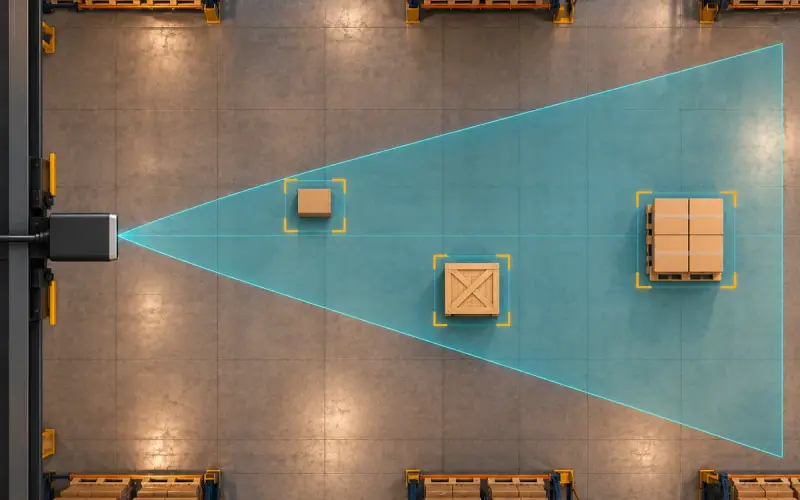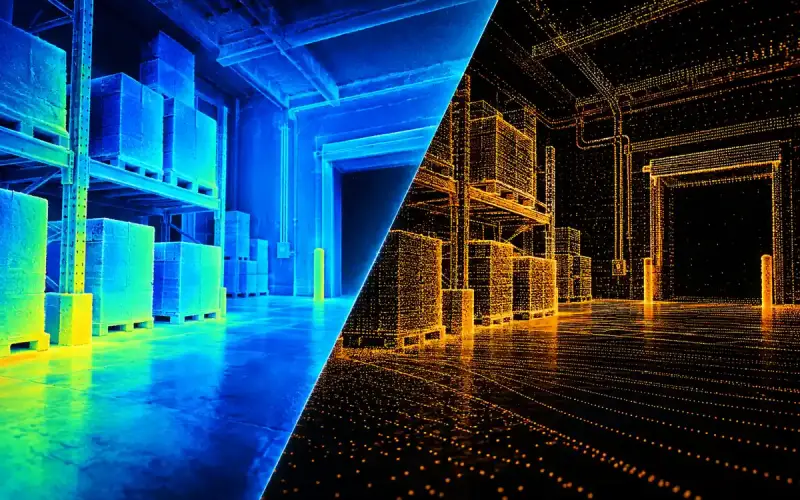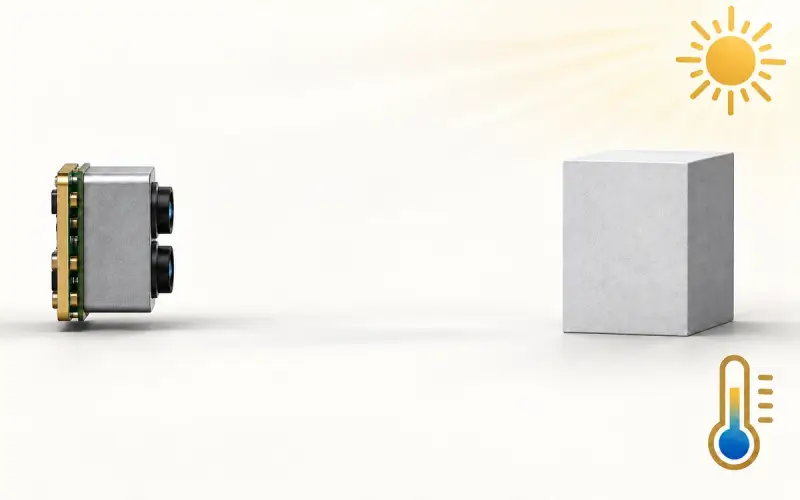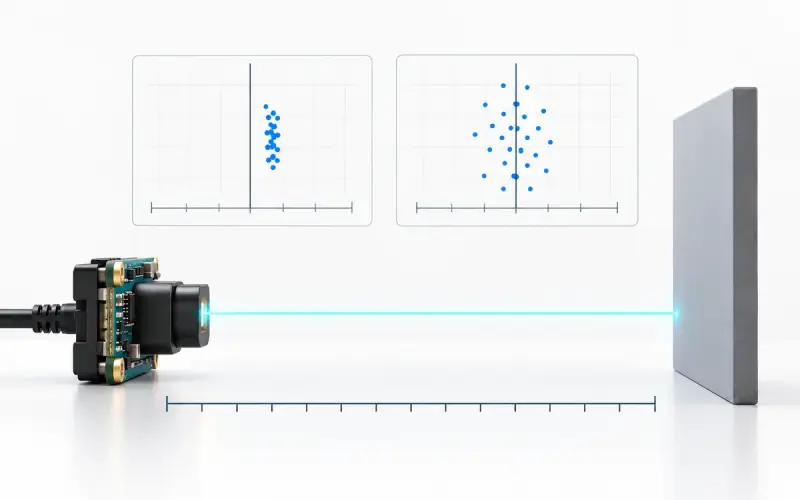

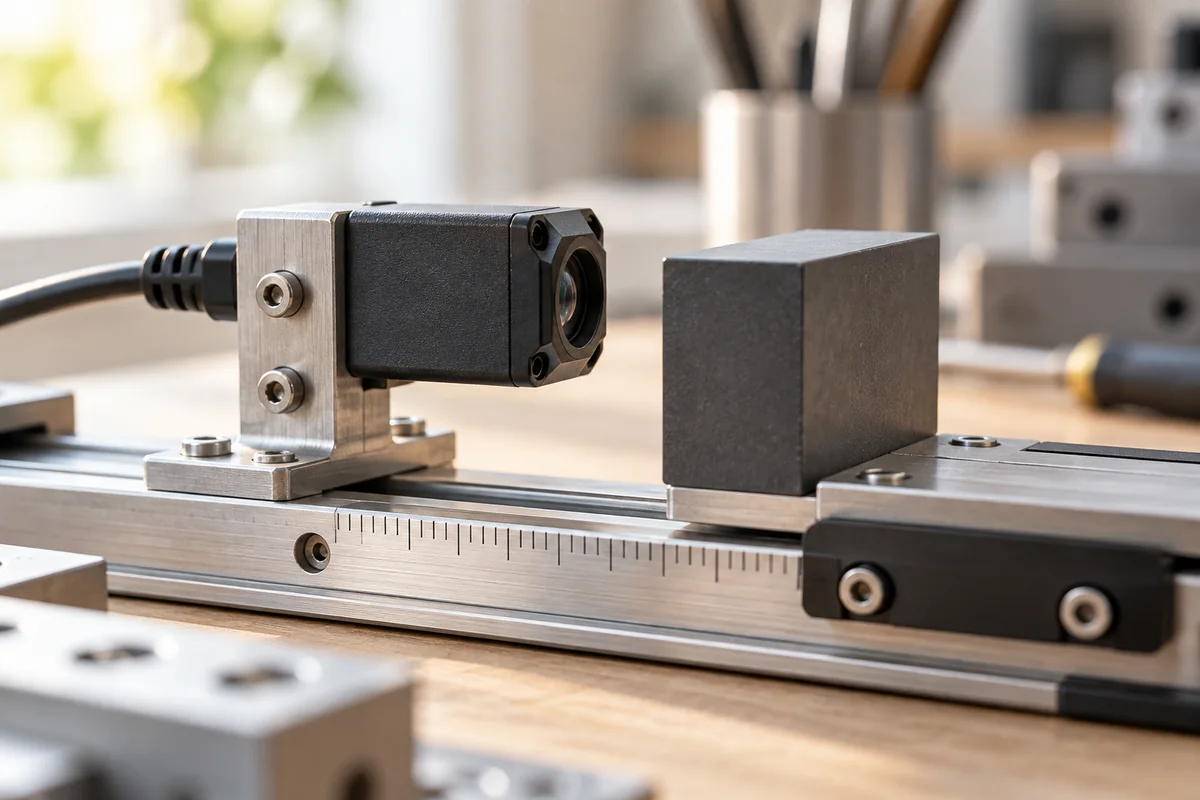
A short-range distance sensor should give your system the measurement it needs at the closest and farthest target positions. For a compact device that reports one distance, single-point Time-of-Flight (ToF) sensing is a useful starting point. A depth camera provides distance samples across a scene when the task needs object position, shape or coverage.
The choice also depends on what you measure. Checking a component's displacement, measuring the space above a liquid and detecting a hand approaching a control are different tasks. Start with the required output and tolerance, then compare sensing methods against the target and installation.
What does short-range measurement mean for your project?
Write down the full working interval, including the nearest target. A sensor selected for its maximum distance may have a blind zone or reduced performance near the optical window. Include any protective cover, mounting offset and expected target movement in that interval.
Next, define the measurement you will use. A controller may need a distance value, a threshold event, several zones or a depth image. These outputs call for different host processing and coverage. A short-range proximity sensor that switches at a threshold can suit presence detection, while a dimensioning task needs numerical measurements and an error budget.
Keep accuracy, repeatability and spatial detail separate. Accuracy concerns agreement with a reference. Repeatability describes variation across repeated readings. A depth camera's resolution describes how many scene locations are sampled; the measurement tolerance at each location needs its own specification and evaluation.
Compare sensing methods by task
Infrared identifies a wavelength region, laser identifies a light source, and ToF identifies a measurement method. A short-range laser distance sensor can use ToF. Organizing a comparison by the measurement task helps avoid treating these labels as mutually exclusive technologies.
| Sensing route | Useful starting task | What to evaluate |
|---|---|---|
| Single-point optical ToF | One distance or a distance-based trigger in a compact design | Minimum distance, target coverage, ambient light, response time and host output |
| Optical triangulation | Displacement or surface-position measurement within a defined working interval | Spot size, target angle, surface finish, measuring interval and specified error |
| Ultrasonic ranging | Distance or level sensing where an acoustic return suits the target | Near-field blind zone, beam coverage, target angle, temperature and enclosure geometry |
| Reflective optical presence sensing | Detecting an approaching or present object | Threshold stability across target colors, reflectivity and surrounding light |
| Inductive or capacitive proximity sensing | Detecting a suitable material at a defined position | Target material, sensing distance, mounting and required switching behavior |
| Multi-zone ToF or a depth camera | Locating objects across an area or obtaining scene geometry | Field of view, valid depth coverage, spatial sampling, frame timing and data processing |
Compare products at the same level of integration. A sensor IC needs a board, power and host integration. A camera module adds optics and a defined data path. A complete industrial sensor may include an enclosure, connectors and application processing. Purchase price alone does not capture those differences.
Choose for the target and installation
Test the actual target surfaces early. A dark surface can return less optical signal; a shiny or angled surface can direct the return away from the receiver. Transparent objects may transmit light, create several returns or expose a background target. Acoustic sensing has its own requirements for target angle, coverage and installation.
For a small target, consider how much of the sensing area it fills. The receiver may also see a wall, floor or enclosure edge. Define whether the system should report the nearest object, the dominant return or a selected region. For depth images, inspect the required region rather than relying only on a central reading.
Use representative lighting and temperature. In optical sensing, emitter wavelength, receiver filtering, acquisition settings and the target all affect the result. Compare the intended configuration under its stated conditions. For a sunlit installation, the outdoor ToF camera selection guide explains the scene and installation checks to include.
Write a requirement that distinguishes ranging from switching
Compare two short-distance tasks separately. A hand-operated control may need an entry threshold, a release threshold and acceptable response time. A displacement measurement needs numerical positions across a working interval and an error budget. A sensor that serves the first task should be evaluated against the second task’s reference measurements before being shortlisted for it.
For a tank or container, define the distance from the sensor to the surface at both the full and empty states. Include the blind region, mounting offset and any internal wall that could contribute a return. For a small part, define the part’s size and background distance as well as the closest position. These requirements let optical ToF, triangulation and ultrasonic candidates be compared on the same task without assigning one universal “best” sensor.
Short-range ToF application tasks
Choose the output around the action your application needs to take. A point distance can support a local threshold, while several regions or a depth image provide spatial information for host processing. The nearest target, usable coverage and response timing belong in the requirement for each task.
| Application task | Required output | Candidate sensing route | Conditions to evaluate | Detailed application guide |
|---|---|---|---|---|
| Hand or fixture activation | Qualified approach and release states | Single-point distance or selected depth regions | Minimum distance, nuisance objects, cover reflections, droplets and release timing | Touchless fixtures |
| Smart-lock wake-up | A qualified approach event for the host | Single-point or area proximity input | Corridor traffic, total power states, wake delay and optical isolation | Smart-lock integration |
| Robot obstacle and floor observation | Selected ground distance or nearby geometry | Point ranging for a defined region; area depth for spatial coverage | Smallest target, floor material, mounting angle, data age and host response | Robot navigation and robot-vacuum sensing |
| UAV ground or obstacle observation | Ground-region distance or spatial depth | Point ranging or an area sensor matched to the host | Aircraft attitude, near/far ground positions, lighting, installed weight and timing | UAV selection |
| Industrial part location and dimensions | Calibrated surfaces, poses or length-width-height results | Depth or RGB-D with task-specific host processing | Target finish, visible edges, camera calibration and reference measurement error | Bin picking and parcel dimensions |
| Object scanning and spatial interaction | Multi-view geometry or aligned scene depth | Depth or RGB-D with registration and pose processing | View overlap, occluded regions, device motion and capture timestamps | 3D reconstruction and AR/VR integration |
| Room and retail observation | Presence, zone count or directional crossing events | Area depth with the selected state or tracking algorithm | Stationary occupants, blind zones, groups, reset rules and retained data | Occupancy monitoring and people counting |
| Care-room activity observation | Defined movement, bed-exit or fall-candidate events | Area depth with event processing and alert handling | Room coverage, ordinary-activity examples, missed events and notification delay | Care monitoring |
| Cabin geometry development | Selected occupant or interaction regions | Area depth with a host perception pipeline | Seat positions, body coverage, trim reflections, sunlight and system timing | Cabin sensing |
Phone focusing, front authentication and application-accessible depth use device-specific hardware and software paths. Check the exact configuration and API in the smartphone ToF guide. For an embedded device, use the ToF integration guide to define the output, interface, optical window and host processing before selecting hardware.
DOMI single-point and depth-sensing options
Our sensing routes cover different data needs:
- DM0301 provides single-point distance output over I2C for compact designs that need a range value or proximity decision.
- DMAS2M001 provides a 40 × 30 dToF depth array with depth, point-cloud and confidence outputs for projects that need spatial information across an area.
- DOMI ToF camera modules provide depth-imaging options for host-based or embedded integration. Compare the specific module's interface, field of view and working distance with your installation.
Share the target material and size, nearest and farthest distances, required tolerance, measurement rate and host interface with us. We can help shortlist a sensing route and discuss the appropriate configuration for evaluation.
A practical evaluation checklist
- Define the output, measurement interval and acceptable error for the application.
- Mount the candidate sensor with the intended window, enclosure and target geometry.
- Compare numerical distance readings with a suitable reference across the working interval. For switching outputs, check the detection and release points instead.
- Repeat with representative target colors, finishes, angles and background objects.
- Include lighting, temperature and motion conditions relevant to the installation.
- Record invalid readings, response time and power alongside the measurement results.
For numerical depth measurements, use the ToF accuracy testing guide to organize reference measurements and error reporting.
FAQs
Which sensor should I use for short-range distance measurement?
Start with the required output. Single-point ToF is a useful candidate for one distance value, optical triangulation deserves consideration for defined displacement tasks, and a depth camera provides measurements across an area. Select the specific device using the working interval, target properties, tolerance and integration requirements.
How do ToF and laser distance sensors relate?
A laser is a light source, and ToF is a ranging method. A laser distance sensor may measure pulse travel time or use a phase-based ToF technique. Other laser sensors use triangulation. Compare the actual measurement principle and product specifications.
What should I evaluate for transparent or reflective targets?
Include the real target material, thickness, angle and background in the test. Check which surface produces the reported measurement and whether it remains usable across the working interval. Optical and acoustic candidates should each be assessed in the intended installation.
Which DOMI route suits a single distance or a depth image?
DM0301 provides a single-point I2C distance route. DMAS2M001 provides array depth data and related spatial outputs. For a larger depth image, compare our ToF camera modules around the required field of view, interface and host processing.
For help choosing a DOMI sensing route, tell us about your measurement task.