
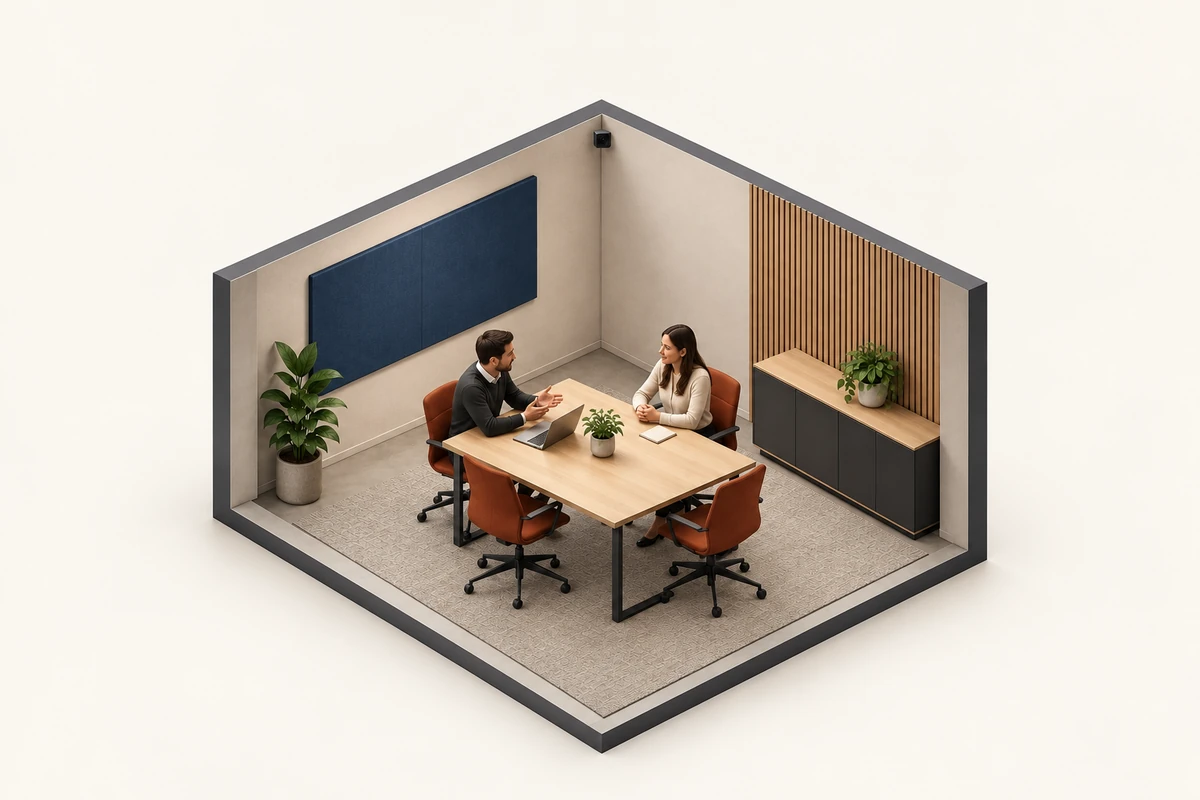
ToF sensing supplies spatial measurements for room-state software. A system can use those measurements to report presence, people in a zone or a running entry-exit balance. Define which output the building application needs before choosing its camera placement, algorithm and data interface.
Define presence, zone count and entry balance
Presence is a yes/no or confidence-based observation within a defined region. A zone count estimates how many people are currently visible in that region. An entry balance starts from a known occupancy and updates it with directional crossings: N(t) = N(0) + entries − exits.
These outputs answer different questions. A doorway counter can support a room balance, while an in-room view can observe a seated occupant. Neither a local presence event nor an accumulated balance establishes a person's identity or the status of every unobserved area.
Choose doorway or in-room observation
Use doorway observation when the task is directional flow across an entrance. Include all entrances in the balance and define the handling of open-plan boundaries. The people-counting installation guide covers crossing events and doorway geometry.
Use an in-room view when the task needs the state of desks, meeting zones or other defined areas. Draw coverage at the relevant body height and include furniture occlusion. Separate a room-wide status from fixture-level activation, which is addressed in touchless bathroom sensing.
Map blind zones and stationary occupants
Test seated, standing and stationary people at zone edges and behind representative furniture. A temporal algorithm that relies on motion can behave differently when an occupant remains still. Retain a defined unknown state when the available measurements do not establish whether an occluded zone is empty.
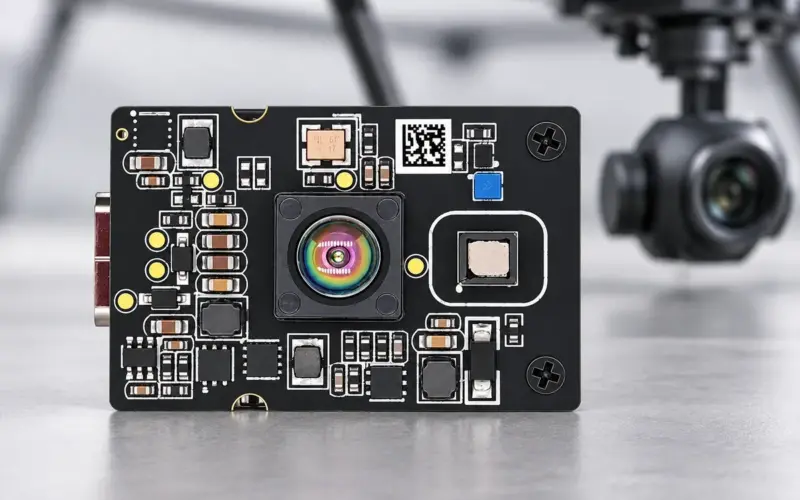
DMOM2508CL provides 320 × 240 MIPI depth over 0.2–2 m for a nearby embedded view. DMOS5030A/5031A offers onboard processing with different range and field-of-view options. DM-RGBD5003A offers a USB RGB-D route over 0.2–5 m for indoor/semi-outdoor use. Match these camera-to-person distances to the installation rather than selecting by ceiling height alone.
Design reset, drift and data-retention policies
An accumulated balance needs a trustworthy initial state and a recovery policy after missed events, power loss or an unobserved entrance. Define when an empty-room reference can reset it and log corrections separately from observed crossings. Avoid silently clamping a negative balance and hiding its cause.
Depth data can support an application designed without RGB capture, but privacy follows from the complete data flow. Decide whether raw frames, trajectories or only aggregated states are retained, how long they remain and who can access them. Use the least detailed data needed by the building function.
Integrate room state with building systems
Define zone identifiers, timestamps, occupancy state, confidence or validity indicators, and stale-data behavior in the host interface. The application or gateway translates these results to the selected lighting, HVAC or building-management protocol. Choose its control delays and manual overrides according to the building use case.
Room utilization is a derived measure with a stated observation window and capacity definition. Report unknown periods separately from occupied and vacant periods. Measure energy or operational outcomes in the actual deployment before attributing savings to sensing.
Evaluate false presence and missed occupancy
Compare time-aligned system states with an agreed reference across occupied, empty and uncertain periods. Report false presence, missed occupied time, count error and state-change latency separately. Test groups, pets or moving objects where relevant, along with sunlight changes and stationary occupants.
Send us the floor plan, observation zones, mounting positions and desired state outputs. We can help select the depth data and processing route for evaluation.
Discuss your evaluation with DOMI.
FAQs
Can doorway counting report current room occupancy?
It can maintain an entry-exit balance when the starting count, entrances and event handling are defined. Resets and reconciliation are needed to manage drift and interruptions.
How should a system handle an occluded occupant region?
Define an unknown or degraded state when the available measurements cannot establish the region's status. Test how the building controller uses that state and the age of the last reliable observation.
Does a depth-only design automatically establish privacy compliance?
Privacy depends on collection, retention, access and use across the complete application. A depth-only route can reduce the types of data collected, with policies designed for the intended deployment.
Can the camera connect directly to every building protocol?
Select a camera interface and a host or gateway for the target building protocol. Agree on the state fields and update behavior before integrating the control system.