
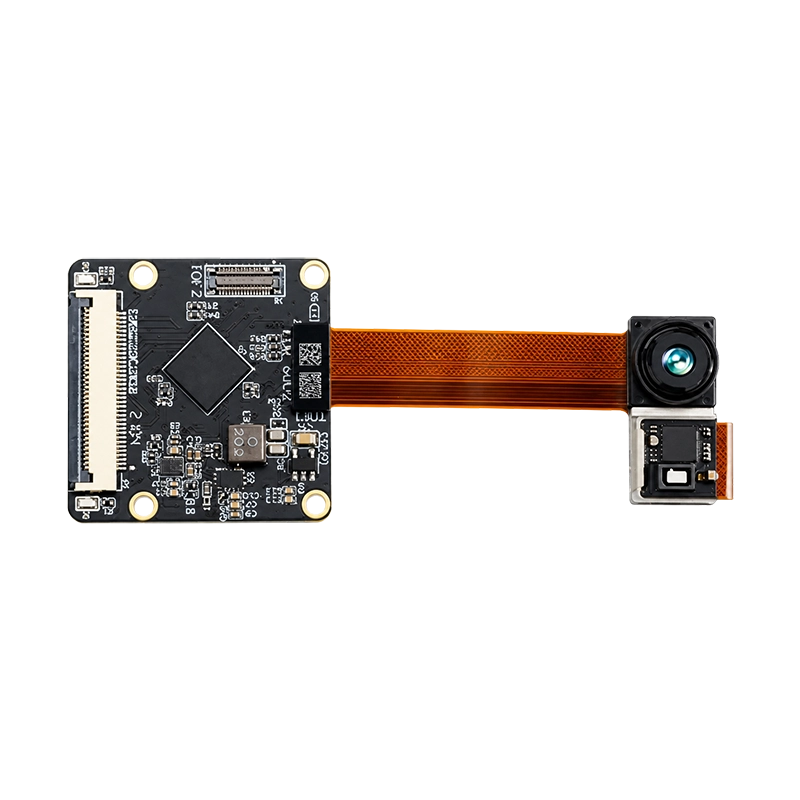
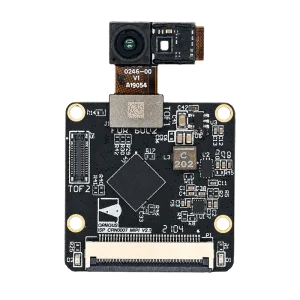
DMOM2508CL 320 × 240 MIPI CSI-2 ToF Depth Camera Module
DMOM2508CL brings near-field ToF sensing to embedded interaction and perception designs. It combines a 320 × 240 global-shutter sensor and 940 nm illumination in a 21.00 × 9.50 × 6.33 mm module head. The 0.2-2 m measurement range and 71.8° horizontal × 56.6° vertical field of view support planning around a defined working region, with a 2-lane MIPI CSI-2 connection to the host pipeline.
Key Highlights
- Build near-field spatial input around 320 × 240 ToF sensing over a 0.2-2 m range.
- Plan hand or object coverage with a 71.8° horizontal × 56.6° vertical field of view.
- Connect the sensing head to an embedded capture pipeline through 2-lane MIPI CSI-2.
- Accommodate the optics in small equipment with a 21.00 × 9.50 × 6.33 mm module head.
Overview
DMOM2508CL uses 940 nm active illumination and a global-shutter sensor for near-field spatial sensing. Operation from 10 to 30 fps gives the host pipeline a frame-rate range to match its acquisition and processing design.
Choose this module around the interaction volume, object region and mounting space. The sensor head connects to a carrier and host through MIPI CSI-2; capture, depth processing and the application algorithm form the rest of the integration path.
- Depth Resolution
- 320 × 240
- Measurement Range
- 0.2-2 m
- Frame Rate
- 10-30 fps
- Data Interface
- MIPI CSI-2, 2 lanes
Applications
AR/VR and gesture input
Use near-field depth sensing as an input to host software for hand and finger tracking or interaction with virtual objects. Set the module position around the user’s working region and the optical coverage needed for the gesture. Our AR/VR integration guide covers the capture and timing considerations.
Robot and object observation
Bring spatial measurements into a robot-gripper or nearby-object perception pipeline. The compact head can be positioned around the object region while the carrier and host handle capture and processing.
Face and people analysis
Depth provides geometric input for host-side face-motion, localization or people-analysis tasks. Our face-system integration guide explains how camera input connects to recognition and authentication software.
Technical specifications
| Parameter | Specification |
|---|---|
| Sensor | Global shutter |
| Resolution | 320 × 240 |
| Pixel size | 15 µm |
| Sensor size | 1/3 inch |
| Measurement range | 0.2-2 m |
| Field of view | 71.8° horizontal × 56.6° vertical |
| Distortion | <2.5% |
| Frame rate | 10-30 fps |
| Illumination | 940 nm; 3 W |
| Input clock | 27 MHz |
| Data interface | MIPI CSI-2; two lanes |
| Sensor supply | 3.3 V; at least 300 mA supply capability |
| VCSEL supply | 4 V; at least 2 A supply capability |
| Module-head dimensions | 21.00 × 9.50 × 6.33 mm |
Host and optical integration
Embedded capture path
Plan the MIPI receiver, two-lane routing, reference clock, carrier and capture driver around the host processor. Choose the depth-processing stage and application output as part of that pipeline. A USB evaluation route uses additional processing and interface hardware; for a complete USB depth-camera option, compare DM5005A.
Supply and installation
Provide the 3.3 V sensor rail and separate 4 V VCSEL rail with the current capability shown in the table. Keep the lens and illuminator clear of enclosure edges, and include the final cover window in optical calibration and mounting design.
Choose the working-distance route
DMOM2508CL uses 940 nm illumination for a 0.2-2 m measurement range. DMOM2808D uses 850 nm illumination for 0.25-4.5 m sensing. Both offer 320 × 240 resolution and a 2-lane MIPI CSI-2 interface. Select the distance, wavelength and power rails around the application; our ToF camera module guide compares the broader integration routes.
FAQs
What working region does DMOM2508CL cover?
The measurement range is 0.2-2 m, with a 71.8° horizontal × 56.6° vertical field of view. Use distance and field of view together to position the module around the interaction or object region.
What does MIPI integration involve?
The module provides a two-lane MIPI CSI-2 interface. The embedded path includes the carrier, receiver, capture driver and depth-processing stage. A USB evaluation connection uses additional processing and interface hardware.
What frame rates and illumination are available?
DMOM2508CL operates from 10 to 30 fps and uses 940 nm, 3 W illumination.
What power supplies does the sensing head need?
The sensor requires 3.3 V with at least 300 mA supply capability. The VCSEL requires a separate 4 V rail with at least 2 A capability.
Discuss your near-field depth design
Share the working region, target objects, host processor and available mounting space. We can help plan the DMOM2508CL capture path, power rails and optical installation for your device.
Need help integrating DMOM2508CL?
Get expert guidance from our sensing engineers on product selection, evaluation samples, system integration, and technical requirements for your application.
You May Also Like
DMAS2M001
DM5005A
DMOM2501C