DOMI ToF sensors and depth modules add distance and spatial information to smart displays, appliances and connected devices. Choose a sensing route for proximity triggers, defined interaction zones, gesture input or depth-assisted auto-framing.
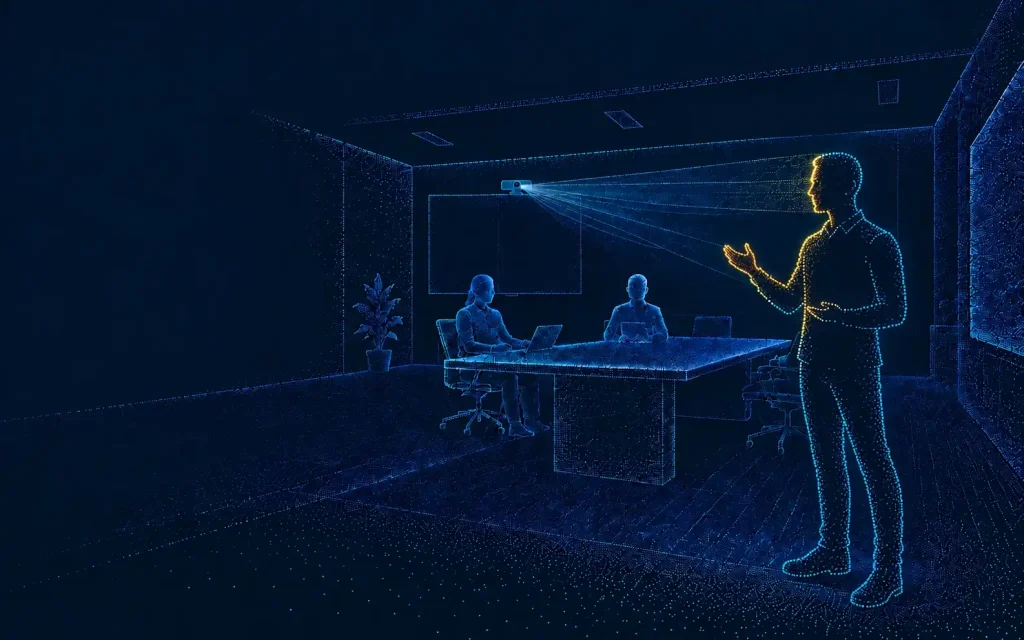
Add 3D ToF depth to RGB and AI pipelines for distance-aware subject selection, auto-framing and face tracking. Explore sensor options, calibration and timing requirements for host systems that control digital cropping or PTZ movement.
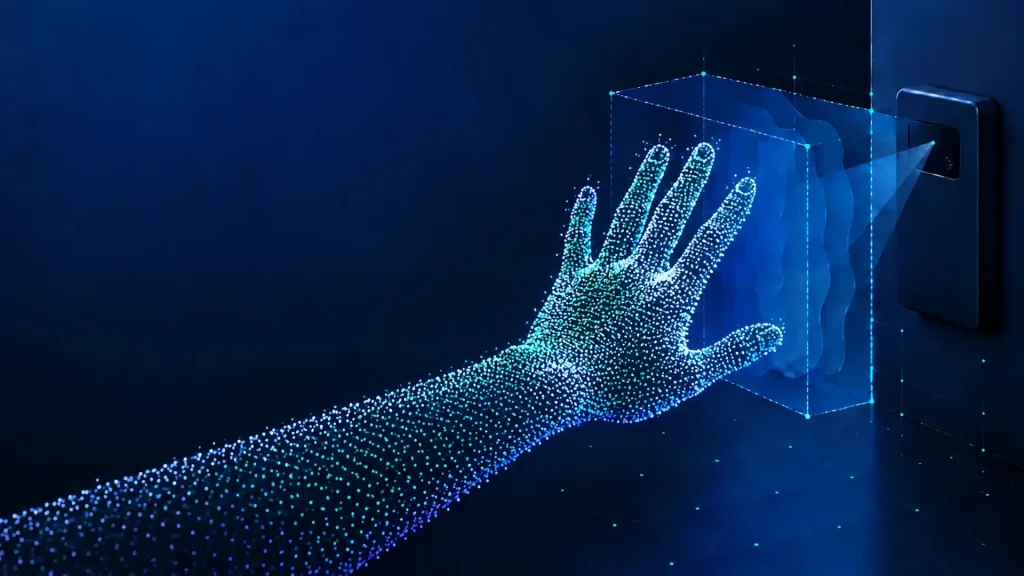
Use 3D ToF depth sensing for touchless gesture interfaces in automotive cabins, appliances and wet-area devices. Explore module selection, interaction-zone design and environmental validation for host-side hand tracking, gesture recognition and device control.
A screen that wakes when someone approaches needs different input from a device that follows a hand or adjusts a video frame. Start with the action, the working area and the information your application needs.
Interaction task
Sensing input
Hardware route
Application work
Proximity trigger
Distance to a target approaching a defined point
DM0301 provides processed single-zone distance over I2C
Set the trigger distance, timing and device response
Region sensing
Target position within defined interaction zones
DMOS5030A / 5031A combine a 100 × 100 ToF sensor with onboard processing
Match the firmware output to zone rules and application states
Continuous gesture input
A sequence of spatial observations across the hand's working area
DMOS5030A provides a 0.2-4.8 m measurement range with a 30° × 30° field of view. DMOS5031A provides a wider 60° × 60° field of view over 0.2-2.5 m. Both integrate a DM3602 processor for ToF and application-specific processing, with firmware-configurable UART or SPI communication. The selected firmware and output format determine how the module and host share the application work.
For embedded hand and motion sensing, DMOM2508CL provides 320 × 240 resolution at 10-30 fps over 0.2-2 m. DMOM2808D provides the same resolution and frame-rate range over 0.25-4.5 m. Both use a 2-lane MIPI CSI-2 interface. Plan the host receiver, depth-processing software and calibration together with the module.
Size the working area around the smallest movement or hand detail the interface needs to distinguish. Include the nearest and farthest positions, mounting angle, cover window, likely obstructions and ambient light. Response time also includes data transfer, application processing and command confirmation.
Integrate the host data pipeline, independent RGB camera and final optical assembly
The host application uses these sensing inputs for subject selection, tracking and framing control. Select the hardware around the room, video architecture and processing platform.
FAQs
Which sensing route fits a proximity trigger?
DM0301 provides a compact single-zone distance input for approach and touchless-trigger tasks. Use a multi-pixel route when the application also needs to distinguish positions within an interaction area.
What information helps shortlist a gesture-sensing module?
Describe the intended gestures, working distance, interaction-area size and smallest hand detail to distinguish. Your host platform, interface, mounting position and response-time target help us compare onboard-processing and embedded depth routes.
Discuss your interaction requirements
Send the interaction task, working-area dimensions and host platform, along with any enclosure or lighting constraints. We can help shortlist a sensing route and identify the data and integration requirements for your evaluation.