
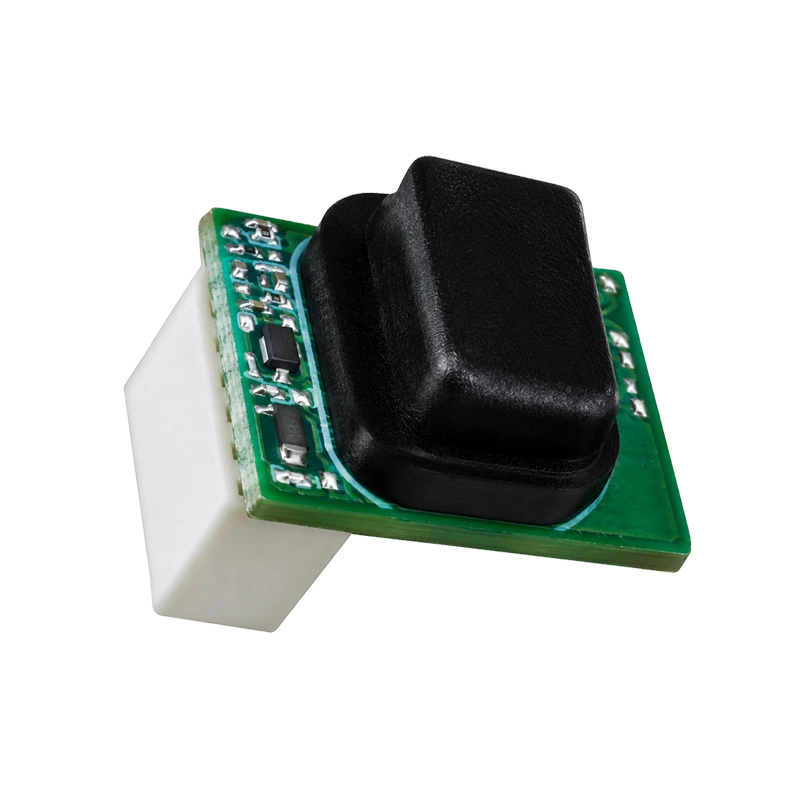
DM-DTOF2002C0 2-120 cm SPAD ToF Proximity Sensor Module
DM-DToF2002C0 provides short-range distance input for embedded products with limited sensing space. A Sharp GP2A03VT00F SPAD ToF sensor and onboard 8051 MCU deliver 2-120 cm ranging with a white-card target through I2C or UART. The 10 × 8 × 7.6 mm module uses a four-pin connection and a 3.0-3.6 V supply.
Key Highlights
- Add near-object distance input through I2C or UART.
- Fit proximity sensing near an enclosure edge or device surface with a 10 × 8 × 7.6 mm module.
- Plan a defined sensing direction using the 25° field of view and 2-120 cm white-card range.
- Budget host acquisition around a 36 ms working cycle and 10 mA current consumption.
Overview
DM-DToF2002C0 combines a 940 nm emitter, SPAD receiver and onboard MCU for short-range measurement. The host receives distance input for approach triggers, object observation and nearby obstacle sensing.
The 2-120 cm range uses a white-card target. At 120 cm with that target, measurement accuracy is ±10%. Use these figures to select a starting configuration around your target surface and installed optics.
- Working Range
- 2-120 cm, white card
- Field of View
- 25°
- Control Interface
- I2C / UART
- Package
- 10 × 8 × 7.6 mm
Applications
Robot proximity channels
Use short-range distance as an input near a robot’s front, side or other defined sensing position. The compact module suits installation near a bumper or enclosure edge. Our robot vacuum sensing guide explains the different roles of obstacle, wall and floor observation.
Approach-triggered smart devices
Connect distance measurements to host events such as waking a device as a user approaches. The smart-lock wake-up guide covers the relationship between the sensing region, host response and power states.
Nearby-object input for UAVs and displays
The small four-pin module provides a distance channel for equipment observing nearby objects or users. Choose its position around the required target region, field of view and host response timing.
Technical specifications
| Parameter | Specification |
|---|---|
| ToF sensor | Sharp GP2A03VT00F; SPAD-based sensing |
| Onboard MCU | 8051 |
| Working range | 2-120 cm; white-card target |
| Measurement accuracy | ±10% at 120 cm; white-card target |
| Field of view | 25° |
| Emitter wavelength | 940 nm |
| Working cycle | 36 ms |
| Supply voltage | 3.0-3.6 V |
| Current consumption | 10 mA |
| Host interface | I2C / UART |
| Connection | Four-pin module |
| Dimensions | 10 × 8 × 7.6 mm |
| Operating temperature | -20 to 70 °C |
| Laser classification | Class 1 under the stated operating conditions; IEC 60825-1:2014, third edition |
| Material compliance | Lead-free; RoHS compliant |
Integration guidance
Host connection and timing
Choose I2C or UART around the controller architecture and provide a regulated 3.0-3.6 V rail. Include the 36 ms working cycle in the application’s acquisition and response timing. We can help align the connector and communication configuration with the host design.
Optical placement
Keep the 25° field of view clear of enclosure edges, ribs and reflective internal surfaces. For a protective window, consider transmission at 940 nm, air gap and tilt together. Use representative target materials with the assembled window when setting distance-trigger thresholds. Include the final optical configuration in the finished product’s laser-safety assessment.
FAQs
What target is used for the range specification?
The 2-120 cm working range uses a white-card target. The ±10% accuracy figure also uses a white-card target at 120 cm.
How can I connect it to a controller?
DM-DToF2002C0 offers I2C and UART interfaces in a four-pin module. It operates from a 3.0-3.6 V supply.
What timing and current figures should I use for planning?
The working cycle is 36 ms and current consumption is 10 mA. Include the acquisition cycle in the host’s event or control timing.
How much space and coverage does the module need?
The body measures 10 × 8 × 7.6 mm, with a 25° field of view. Keep that field clear of the enclosure and position the module around the target region.
Discuss your proximity-sensing application
Tell us the target distance and material, sensing direction and host interface. We can help plan the module placement and distance-input path for your device.
Need help integrating DM-DTOF2002C0?
Get expert guidance from our sensing engineers on product selection, evaluation samples, system integration, and technical requirements for your application.
You May Also Like
DM0301
DMS604