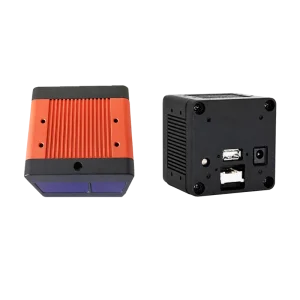

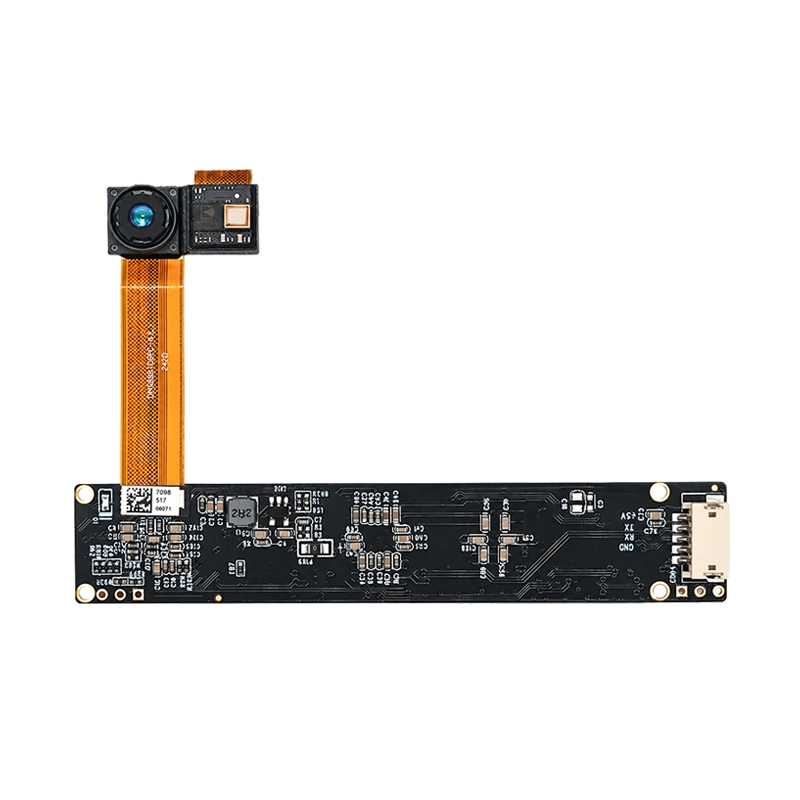
DM5005A QVGA USB 2.0 UVC ToF Depth Camera
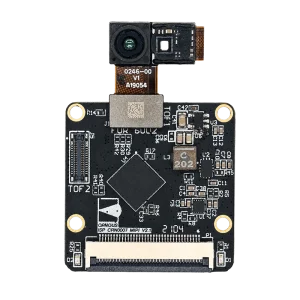
DM5005A brings 320 × 240 depth sensing, infrared images and point-cloud data to your host through USB 2.0 and UVC 1.2. Choose the 940 nm version for a 0.2–2 m working range or the 850 nm version for 0.3–5 m, and build the camera into your own enclosure.
Key Highlights
- Give robot perception and measurement software depth, IR and point-cloud inputs from a QVGA ToF camera.
- Choose a working range for your sensing area with separate 940 nm and 850 nm configurations.
- Connect the camera to a host through Micro USB using USB 2.0 and UVC 1.2.
- Design the enclosure and cooling around your equipment using the 90.7 × 17.2 mm main board.
Overview
DM5005A combines a QVGA MIPI depth module with a SigmaStar processing platform and a USB host connection. Its depth, infrared and point-cloud outputs give your software scene information for object localization, measurement and spatial interaction.
The camera supports up to 30 fps with a 70° horizontal × 50° vertical field of view. The 940 nm and 850 nm versions serve different working-distance requirements, so you can select the optical configuration around the space your application observes.
The board is supplied for integration into your product. You provide the enclosure and heatsink, with room for the optical apertures, USB cable and thermal path.
- Resolution
- 320 × 240
- Range
- 0.2-2 m / 0.3-5 m
- Interface
- USB 2.0 / UVC 1.2
- Output
- Point cloud / Depth / IR
Applications
Robot perception
Use depth and point-cloud data as inputs to object localization, obstacle perception and manipulation software. The USB connection provides a route into a host-based robot vision pipeline.
3D measurement and reconstruction
Bring depth maps and point-cloud coordinates into shape-capture, reconstruction and calibrated dimensioning workflows. Plan camera placement around the target size, working distance and measurement region.
Gesture and spatial interaction
Provide depth and IR inputs to gesture, presence and spatial-interaction software. Choose the wavelength version around the user region and installation distance.
Technical Specifications
Depth sensing and optics
| Parameter | Specification |
|---|---|
| Depth resolution | 320 × 240 (QVGA) |
| Frame rate | Up to 30 fps |
| 940 nm version working range | 0.2–2 m |
| 850 nm version working range | 0.3–5 m |
| Field of view | 70° horizontal × 50° vertical |
Host connection and integration
| Parameter | Specification |
|---|---|
| Processing platform | SigmaStar SoC with QVGA MIPI module |
| Host connection | Micro USB; USB 2.0 |
| Protocol | UVC 1.2 |
| Output data | Point cloud, depth and IR |
| Output format | RAW 12-bit |
| SDK platforms | Windows 7 / 8 / 10 and Linux |
| Main-board dimensions | 90.7 × 17.2 mm |
| VCSEL and sensor power consumption | Less than 3 W |
| Enclosure and heatsink | Customer-designed |
Integration
Connect the camera to your host
Plan the USB connection and host application around the depth, IR or point-cloud data your project uses. Windows and Linux SDK options provide a starting point for camera access and development. Include your operating-system version and required output in the project brief so we can discuss the software configuration.
Build the optical and thermal assembly
Reserve the board envelope together with space for the connector, cable and heatsink. Keep the receive lens and VCSEL emission path clear of enclosure edges. Match the cover window to the selected 850 nm or 940 nm version, and include the installed optics in calibration and measurement checks.
For a complete vision workflow, explore our robot perception guide. For a camera that also provides RGB images, compare DM-RGBD5003A.
FAQs
What data does DM5005A provide?
DM5005A provides point-cloud, depth and infrared data. It uses a 320 × 240 ToF depth module, supports up to 30 fps and lists RAW 12-bit as the output format.
Which wavelength version should I choose?
Choose the 940 nm configuration for a 0.2–2 m working range or the 850 nm configuration for 0.3–5 m. Both have a 70° horizontal × 50° vertical field of view. Share your working distance, target materials and lighting with us to discuss the configuration for your project.
How does DM5005A connect to the host?
The camera connects through Micro USB using USB 2.0 transport and the UVC 1.2 protocol. SDK platforms include Windows 7, Windows 8, Windows 10 and Linux.
Can I design the camera enclosure around my product?
Yes. The 90.7 × 17.2 mm main board supports a customer-designed enclosure and heatsink. Include optical clearance, the USB connection and heat dissipation in the mechanical design.
Technical Resources and Evaluation
Download the DM5005A datasheet, Rev. 1.0.
Tell us your host platform, working distance, required data outputs and available mounting space. We can discuss the wavelength option and integration needs for your camera project. Discuss DM5005A with DOMI.
Need help integrating DM5005A?
Get expert guidance from our sensing engineers on product selection, evaluation samples, system integration, and technical requirements for your application.
You May Also Like
DMAS2M001
DMOM2508CL
DMOM2501C