
DMP300KP 905 nm 300 W Pulsed VCSEL
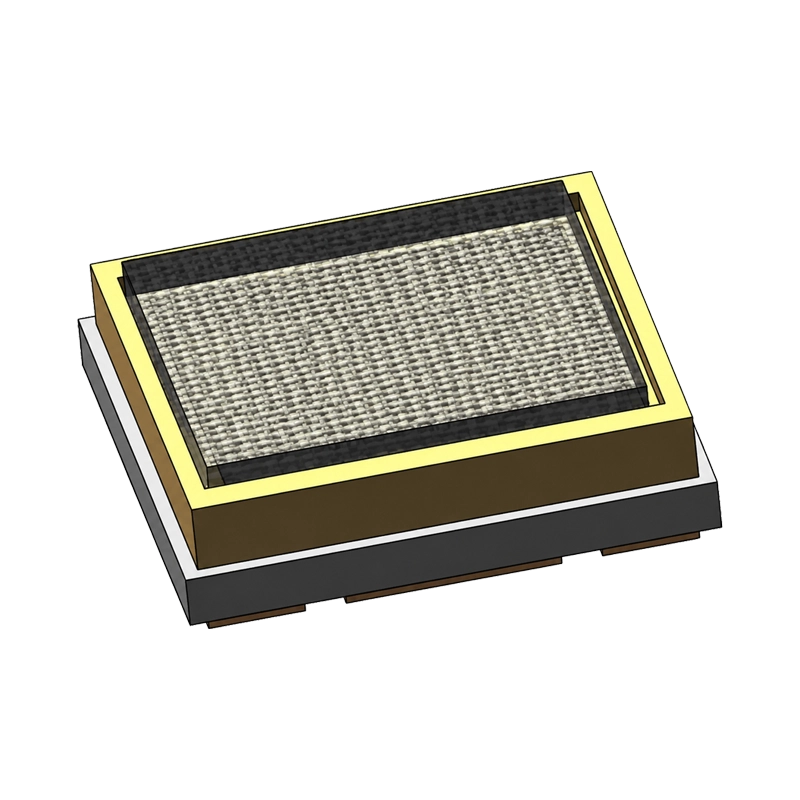
DMP300KP provides 905 nm pulsed illumination for ToF and 3D sensing transmitters in a 5.2 × 5.2 × 1.55 mm AlN ceramic package. Typical pulsed optical output is 300 W at Ts = 25 °C, IF = 61 A, a 5 ns pulse width and 0.025% duty cycle. At the same test condition, typical beam divergence is 40° horizontal × 30° vertical.
Key Highlights
- Build a nanosecond-pulsed transmitter around 300 W typical optical output at Ts = 25 °C, 61 A, 5 ns and 0.025% duty cycle.
- Plan transmitter optics with a 40° horizontal × 30° vertical typical beam divergence at the stated pulse condition.
- Match the emitter to a 905 nm optical path using a peak wavelength range of 895-915 nm under the stated test condition.
- Fit the emitter into compact transmitter layouts with a 5.2 × 5.2 × 1.55 mm AlN ceramic package and a center pad available for thermal use.
Overview
DMP300KP is a pulsed VCSEL emitter for transmitter designs that combine a laser driver, optics and a receiving system. Its 905 nm typical peak wavelength and rectangular emission pattern provide optical inputs for ToF illumination, 3D scanning and related sensing designs.
The 300 W typical output is characterized at the pulse condition shown below. At that condition, forward voltage is 25 V typical and power-conversion efficiency is 20% typical. Use these values together when assessing the emitter and driver architecture.
- Wavelength
- 895-915 nm (905 nm typ.)
- Peak Output
- 300 W typ. @ 61 A, 5 ns
- Beam Divergence
- 40° H × 30° V typ.
- Package
- 5.2 × 5.2 × 1.55 mm AlN
Applications
ToF illumination and 3D measurement
Use DMP300KP as the illumination component in a ToF transmitter. Its wavelength, pulsed output and divergence help define the emitter side of a depth-sensing, 3D-scanning or volume-measurement design. Pair the transmitter with the receiver and processing architecture selected for your measurement task.
Spatial interaction and scene sensing
Pulsed illumination can support sensing systems for gesture interaction, AR/VR, people-flow measurement and obstacle observation. The emitter’s compact package supports layouts where the driver, optics and sensing hardware share limited installation space.
Technical specifications
Electro-optical characteristics
Electro-optical characteristics use Ts = 25 °C. The pulsed-drive test condition is IF = 61 A, Tp = 5 ns and DC = 0.025%.
| Parameter | Minimum | Typical | Maximum | Unit |
|---|---|---|---|---|
| Peak wavelength | 895 | 905 | 915 | nm |
| Pulsed optical output | 300 | W | ||
| Forward voltage | 25 | 30 | V | |
| Slope efficiency | 4.5 | 5 | W/A | |
| Power-conversion efficiency | 20 | % | ||
| Horizontal beam divergence | 40 | ° | ||
| Vertical beam divergence | 30 | ° | ||
| Spectral width | 4 | nm | ||
| Wavelength coefficient | 0.06 | 0.07 | nm/°C |
Threshold current at Ts = 25 °C is 1.5 A typical and 4.5 A maximum.
Absolute maximum ratings
These are device limits. Select the operating pulse train and driver around the intended electrical and thermal design; the 300 W characterization point is 61 A, 5 ns and 0.025% duty cycle at Ts = 25 °C.
| Parameter | Rating |
|---|---|
| Operating temperature | -20 to 85 °C |
| Storage temperature | -40 to 85 °C |
| Pulse duration | 50 ns maximum |
| Duty cycle | 0.05% maximum |
| Soldering temperature | 260 °C for 5 s |
Package and assembly
The AlN ceramic body measures 5.20 × 5.20 × 1.55 mm, with a general drawing tolerance of ±0.15 mm. In the bottom-view drawing, the side pads identify positive and negative polarity. The center pad is marked N.C. and may be used as a thermal pad.
Use ESD-controlled handling, proper grounding and protection against electrical overstress and surge current. Coordinate the PCB thermal path, driver and pulse train during transmitter development.
Pb-free SnAgCu reflow profile
| Profile feature | Requirement |
|---|---|
| Preheat / soak | 150-200 °C for 60-120 s |
| Ramp-up rate | 3 °C/s maximum |
| Liquidus temperature / time above | 217 °C / 60-150 s |
| Peak package-body temperature | 260 °C |
| Time within 5 °C of peak | 30 s |
| Ramp-down rate | 6 °C/s maximum |
| Time from 25 °C to peak | 8 min maximum |
Technical resources
The DMP300KP product specification, Rev1.0 provides the electro-optical tables, package drawing, characteristic curves and assembly guidance.
FAQs
Under what conditions does DMP300KP provide 300 W output?
The 300 W value is typical pulsed optical output at Ts = 25 °C, IF = 61 A, Tp = 5 ns and DC = 0.025%. It describes that characterization point.
What wavelength and divergence should I use for optical planning?
At the stated pulse condition, peak wavelength is 905 nm typical within a range of 895-915 nm. Typical beam divergence is 40° horizontal × 30° vertical, with a maximum spectral width of 4 nm.
What package and pad arrangement does the emitter use?
DMP300KP uses a 5.2 × 5.2 × 1.55 mm AlN ceramic package. The bottom-view drawing identifies positive and negative side pads and a center N.C. pad available for thermal use.
What should I include in a transmitter integration discussion?
Share your receiver wavelength, illumination region, pulse train, driver and available PCB space. We can help review the emitter’s optical and electrical characteristics alongside your thermal design and laser-safety assessment.
Discuss your pulsed VCSEL transmitter
Bring your ToF or 3D-sensing transmitter requirements to our team. We can help evaluate DMP300KP around the optical coverage, drive conditions and package layout your design needs.
Need help integrating DMP300KP?
Get expert guidance from our sensing engineers on product selection, evaluation samples, system integration, and technical requirements for your application.
You May Also Like
DMP1KKM
DMP200W