3D ToF Solutions for Smart Logistics & Supply Chains
Our ToF cameras and modules provide spatial depth data for logistics applications. Explore sensing tasks, related solutions and candidate hardware around your workflow and integration platform. The paths below focus on parcel, carton and pallet measurement at static stations or on conveyors.
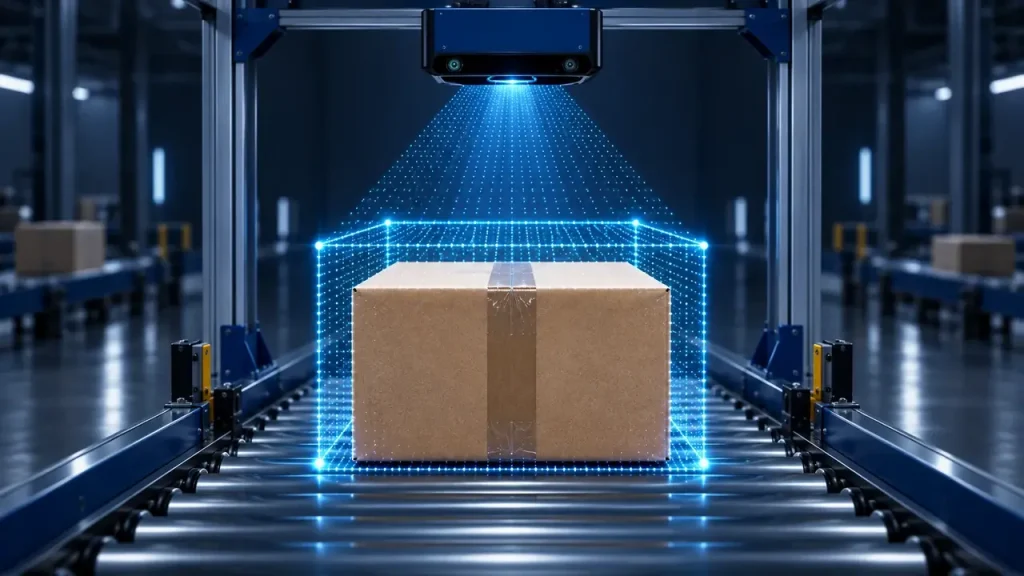
Use 3D ToF depth data for static and conveyor-based parcel, box and pallet dimensioning. Explore camera selection, calibration and integration requirements for host systems that calculate dimensions and volume and connect results to DWS or WMS workflows.
Define the measurement zone around the complete object and the reference table, belt or floor used by your processing pipeline.
Task
Define the scene
Hardware starting point
Evaluation focus
Static parcel and carton measurement
Object size, presentation and camera-to-surface distance
DM-RGBD5003A for RGB and depth; DM5005A for USB depth and IR
Calibrated reference plane, edge coverage and repeatability across representative packaging
Conveyor parcel measurement
Belt width, package spacing, line speed and trigger position
USB cameras for host-side evaluation; DMOM2808D for an embedded MIPI route
Capture timing, motion, duplicate-read policy and complete processing time
Pallet and stacked-load measurement
Full load height, footprint, overhang and visible surfaces
Compare DM-RGBD5003A and DMOM2808D against the required viewing envelope
Coverage at the tallest load, occlusion, viewpoint layout and load-profile acceptance
Our parcel dimensioning and volume measurement guide explains calibrated geometry, point-cloud processing and DWS/WMS integration. Use it to develop the measurement pipeline once the task and hardware route are defined.
Compare candidate cameras and modules
Choose a configuration around the working distance, required surface detail and available processing platform.
320 × 240 at 10–30 fps; 0.25–4.5 m; 2-lane MIPI CSI-2
Embedded camera integration with a custom host and mechanical assembly
Carrier board, capture driver, depth processing and calibration
These entries describe model specifications with their stated options and conditions. Evaluate final dimensional tolerance in the assembled station using the intended materials, lighting and object speeds.
Include the smallest and largest objects, mounting space, line speed and required dimensional tolerance in your brief. Specify length, width, height, bounding volume or load profile, together with units and the treatment of irregular shapes and overhangs.
Evaluate representative objects in the final geometry
Use a calibrated reference surface and independently measured objects. Include packaging, tape, dark or reflective surfaces, installation lighting and production motion. Record error, repeatability, valid-depth coverage and exception handling with the camera configuration and calibration version.
Connect the pipeline to logistics software
Plan acquisition, segmentation and geometry processing on the selected host. Define measurement IDs, timestamps, dimensions, units and quality status for hand-off to DWS, PLC or WMS software. The host integration determines the scale, barcode and business-system connections used in the workflow.
Logistics selection FAQ
Which camera should I start with for parcel measurement?
DM-RGBD5003A is a USB starting point when your host uses color and depth together. DM5005A offers USB depth, point-cloud and IR data. DMOM2808D provides a MIPI route for embedded designs. Match their coverage and distance specifications to your station, then evaluate the final measurement result.
What changes when measurement moves to a conveyor?
A conveyor adds line speed, trigger timing, package spacing and motion to the acquisition plan. Include the time from capture to published measurement and define how software associates each result with a package. The dimensioning guide covers the detailed processing route.
What information helps DOMI shortlist hardware?
Share object dimensions and materials, mounting space, lighting, line speed, host platform and required outputs. We can help compare camera and module routes around those requirements.
Discuss your logistics measurement project
Send us your measurement envelope, target tolerance and integration platform. Talk to our team about logistics sensing to discuss candidate hardware and an evaluation path for your station.