
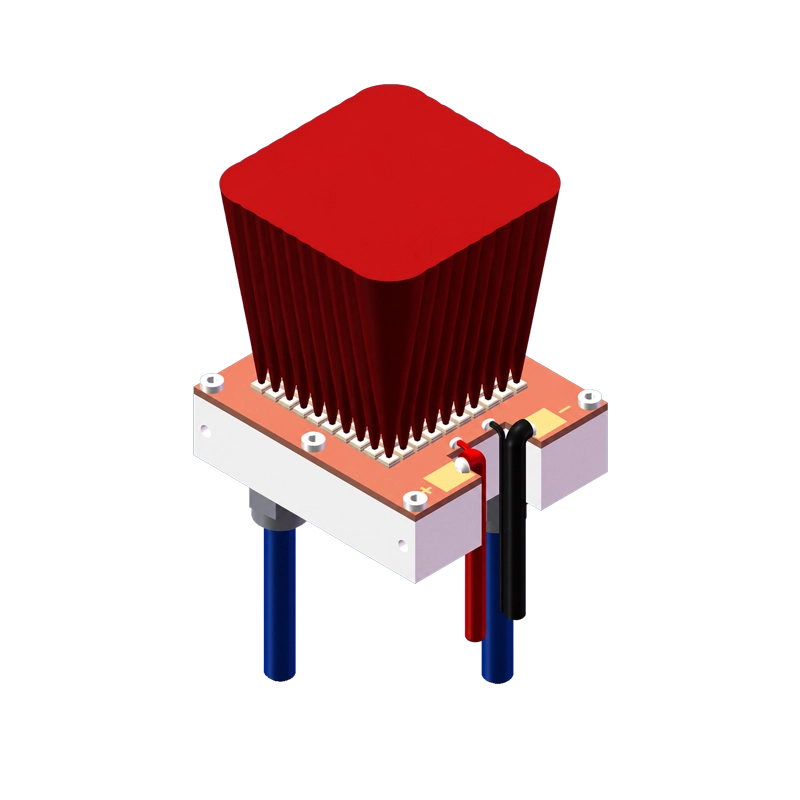
DMP200W 980 nm 200 W CW VCSEL Module
DMP200W provides a water-cooled 980 nm laser source for OEM heating and surface-processing equipment. At a case temperature of 25 °C, its 200 W CW optical-output operating point uses 20 A typical current and 45 V typical voltage. NTC monitoring provides a temperature-sensing input for your equipment.
Key Highlights
- Build a heating or surface-processing optical assembly around a 980 nm CW VCSEL source.
- Size the driver around the 200 W CW operating point, with 20 A and 45 V typical electrical values at Tc = 25 °C.
- Integrate the module with a water-cooling loop using 15–25 °C water at a flow rate of at least 10 L/min.
- Add temperature sensing to your control electronics through the module's NTC monitor connection.
Overview
DMP200W combines a high-power VCSEL source, water-cooled package and NTC temperature monitoring for integration into OEM laser equipment. Its 980 nm emission supports optical-source selection for laser heating and surface-processing designs.
Two CW optical-output operating points are provided at Tc = 25 °C. At 200 W, the typical current and voltage are 20 A and 45 V. At 30 W, they are 8 A and 42 V. Use the operating point relevant to your design when planning the driver and cooling system.
Typical irradiation footprint dimensions are 6 × 6 cm at a distance of 6 cm and 6.5 × 6.5 cm at 10 cm. These dimensions help you plan the target position and optical assembly. The module’s plan-view outline is 75 × 65 mm, with separate laser and NTC connections.
- Peak Wavelength
- 980 nm
- Optical Operating Point
- 200 W CW at Tc = 25 °C
- Cooling Water
- 15-25 °C; ≥10 L/min
- Plan-View Outline
- 75 × 65 mm
Applications
OEM laser heating equipment
Use the 980 nm CW source as part of a heating head or thermal-process assembly. Match the source, delivery optics and working distance to the target material and heating task.
Surface-processing equipment
Integrate the module into a defined optical and thermal process. Use representative material samples to establish the delivered power, exposure and working arrangement for the equipment.
Technical Specifications
Operating and cooling conditions
| Parameter | Specification |
|---|---|
| Peak wavelength | 980 nm |
| Optical-output operating points | 200 W CW and 30 W CW at Tc = 25 °C |
| Cooling method | Water cooling |
| Cooling-water temperature | 15–25 °C |
| Cooling-water flow rate | At least 10 L/min |
| Operating ambient temperature | 15–40 °C |
| Storage temperature | 5–85 °C |
| NTC monitor | B value of 3930 K |
Electrical characteristics
The following values apply at Tc = 25 °C and the stated CW optical-output point.
| Parameter | Optical-output point | Typical | Maximum |
|---|---|---|---|
| Operating current | 200 W CW | 20 A | 24 A |
| Operating voltage | 200 W CW | 45 V | 50 V |
| Operating current | 30 W CW | 8 A | 10 A |
| Operating voltage | 30 W CW | 42 V | 46 V |
Optical coverage and mounting
| Parameter | Specification |
|---|---|
| Irradiation footprint at 6 cm distance | 6 × 6 cm, typical |
| Irradiation footprint at 10 cm distance | 6.5 × 6.5 cm, typical |
| Module plan-view outline | 75 × 65 mm |
| Unmarked drawing tolerances | ±0.2 mm |
| Laser terminals | LASER + and LASER − |
| Temperature-monitor connection | NTC Temp-Monitor |
Integration
Driver and cooling
Select a current-regulated driver around the chosen CW operating point. Include voltage headroom, cable losses, startup and shutdown behavior in the electrical design, and provide surge protection for the laser.
Connect the module to a cooling loop that delivers 15–25 °C water at at least 10 L/min. Plan hose routing, mounting access and temperature monitoring together with the driver and equipment controls.
Optical assembly and handling
Set the target position and delivery optics around the required exposure area. Measure delivered optical power and the beam profile at the equipment’s working plane as part of process setup.
Use the package outline for mechanical planning. Follow grounded, ESD-controlled handling practices for personnel and equipment. Include optical shielding, access controls and laser-safety review in the complete equipment design.
FAQs
What current and voltage are associated with the 200 W CW point?
At Tc = 25 °C and 200 W CW optical output, operating current is 20 A typical / 24 A maximum and operating voltage is 45 V typical / 50 V maximum. These values describe that electro-optical operating point.
What cooling conditions does DMP200W use?
The module uses water cooling, with a water temperature of 15–25 °C and a minimum flow rate of 10 L/min. Its operating ambient temperature is 15–40 °C.
What irradiation footprint dimensions are provided?
Typical footprint dimensions are 6 × 6 cm at a 6 cm working distance and 6.5 × 6.5 cm at 10 cm. Use these target-plane dimensions when planning the optical assembly and target position.
How can I include temperature monitoring?
DMP200W has a separate NTC Temp-Monitor connection with a B value of 3930 K. Include the monitor interface and desired control behavior in your equipment brief so we can discuss the integration details.
Technical Resources and OEM Enquiries
Download the DMP200W specification, Rev. 1.1, 19 April 2025.
Share your target material, required optical output, working distance, driver and cooling arrangement, together with the evaluation quantity and project schedule. We can discuss the module configuration and quotation for your OEM equipment. Contact DOMI about DMP200W.
Need help integrating DMP200W?
Get expert guidance from our sensing engineers on product selection, evaluation samples, system integration, and technical requirements for your application.
You May Also Like
DMP1KKM
DMP300KP