
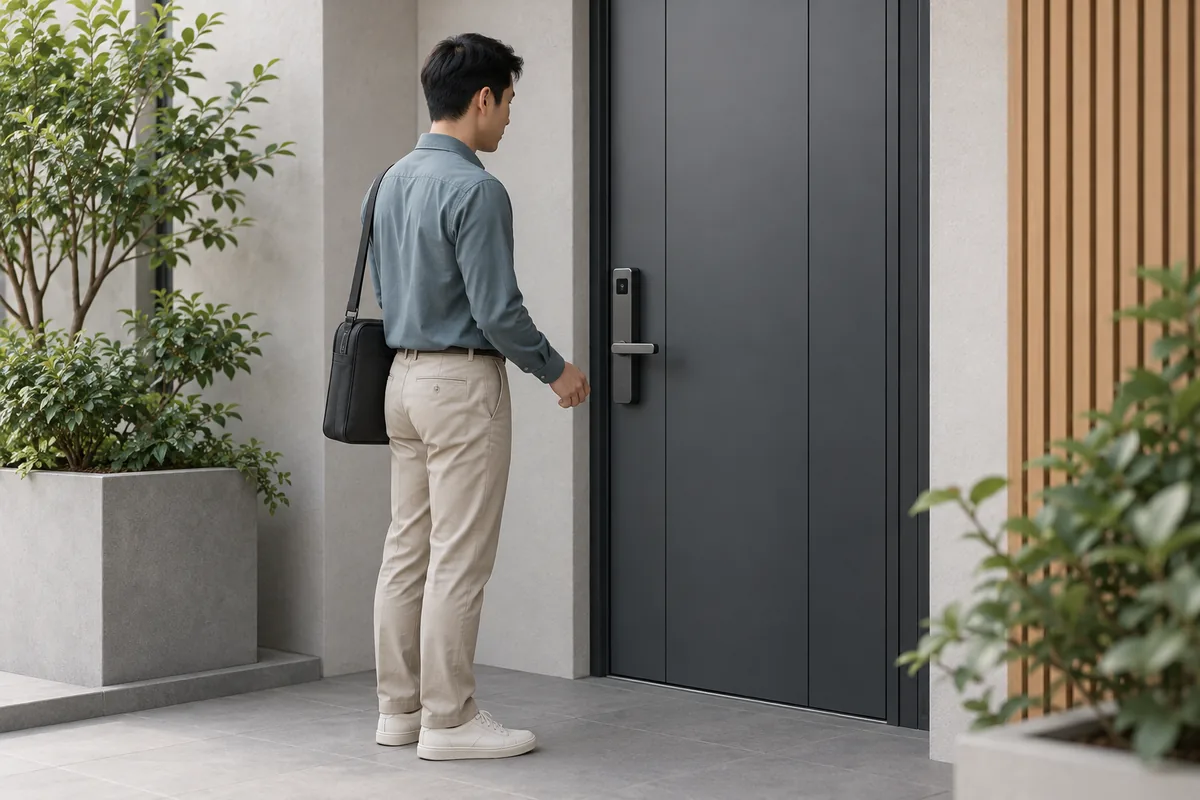
A smart door lock can use optical ToF distance measurements to detect approach and wake a higher-power capture subsystem. The integration task is to recognize relevant activity in front of the lock while managing corridor traffic, response delay and battery use. Define that wake-up function separately from face authentication and unlocking.
Separate approach, wake, face capture and unlock
An approach sensor reports a distance or region condition. The host evaluates that condition, powers or activates the capture subsystem and waits for a usable sample. Authentication software then processes the sample, and the lock controller applies its authorization policy before operating the actuator.
Specify the interface and timeout between each stage. Optical ToF measures using light; ultrasonic time-of-flight uses sound and has a different transducer and integration path. Select the intended sensing architecture before comparing module specifications.
Define detection zone and nuisance motion
Draw the wake zone relative to the door panel, user height, handle and corridor. Include side traffic, a person standing nearby, opening the door and an object left in the zone. Choose range thresholds and observation regions from that layout.
DM0301 supplies single-zone processed distance through I²C, with measurement rates up to 50 Hz. A single range is useful when the activation zone can be represented by that view. DMOS5030A/5031A offers an area-sensing route with onboard processing, and DMOM2508CL supplies MIPI depth where the host needs a depth image. Choose the output detail according to the zone logic.
Budget sampling, wake delay and total power
Measure sensing, host sleep, host processing, illumination, authentication and actuator consumption as separate states. Average power follows the time spent in each state plus the energy of events over the observation period. Include false wakes and repeated retries, which can dominate an apparently low-power standby design.
Sampling interval adds delay before an approach is observed. The complete user response also includes qualification time, host wake, camera startup, capture, authentication and actuation. Test this chain with timestamps; a sensor's maximum measurement rate does not specify the complete lock's wake delay or battery life.
Design cover window and optical isolation
Choose cover material and coatings for the sensor wavelength. Evaluate the final thickness, spacing and optical aperture, and separate transmit and receive paths to limit cover-induced coupling. Account for the bezel, gasket, fingerprints, scratches and door-surface reflections.
Calibrate or characterize the module in its installed optical assembly according to its integration requirements. Test the full user-distance range after assembly, including direct and side light. The face camera may need different optical openings and alignment from the approach sensor.
Implement debounce and sleep-return states
A useful state sequence is idle, approach candidate, qualified wake, active capture and return to idle. Require persistence for a candidate where appropriate, and use different activation and release thresholds to avoid repeated toggling near a boundary. Set a maximum active time for a person or object remaining in view.
Handle invalid distance, stale samples, host startup failure and interrupted authentication explicitly. Choose a sleep-return rule that lets the next valid user wake the lock without creating a rapid retry loop.
Evaluate corridor traffic and door movement
Measure wanted-wake success, false wakes per observation period, wake delay and total energy on representative traffic sequences. Repeat with door opening and closing, users of different heights, dark clothing, ambient-light changes and a contaminated cover.
For the downstream capture chain, see ToF in face-recognition systems. Send us the door geometry, target zone, interface, expected daily events and power-state budget to discuss a suitable sensing route.
Discuss your evaluation with DOMI.
FAQs
Which parameters matter for an approach sensor?
Prioritize the required zone, near and far distances, usable field of view, sampling timing, interface and installed optical behavior. Evaluate them with the host wake logic and actual corridor traffic.
Does an approach event authorize unlocking?
It starts the selected wake or capture process. The host performs authentication and applies the lock's access policy before the actuator receives an unlock command.
How should battery use be estimated?
Measure the power and duration of standby, sensing, wake, capture, authentication and actuation states. Include daily event counts, false wakes and retries in the total-energy calculation.
Why use different activation and release thresholds?
Hysteresis helps prevent repeated state changes when a person or object remains near a distance boundary. Combine it with suitable persistence and timeout rules, then test the resulting behavior.