
A direct time-of-flight LiDAR system measures optical round-trip timing and converts it to distance. Its emitter is one part of a chain that also includes transmit optics, a receiver, timing electronics and signal processing. Select a pulsed VCSEL against that complete architecture and its intended operating conditions.
Separate emitter, receiver and LiDAR system
The emitter supplies optical pulses. The receiving optics and detector collect returns, and the timing and processing chain identifies relevant return events. System geometry, calibration and signal interpretation produce the reported distance or point cloud.
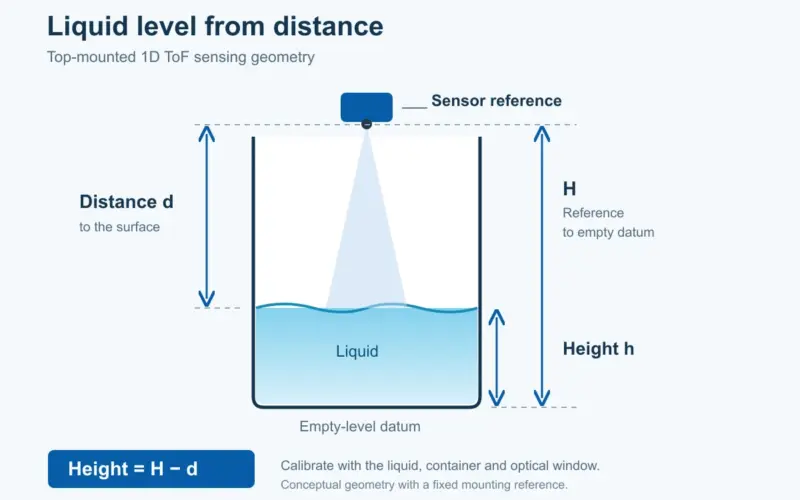
For a measured round-trip interval Δt, the basic ranging relationship is d = cΔt/2. Range precision also depends on timing uncertainty, signal statistics, pulse shape and processing. The emitter's peak power alone does not specify detection distance, resolution or environmental performance.
Define wavelength, pulse and optical-power conventions
Record wavelength, peak optical power, pulse width, repetition rate, duty cycle, pulse shape and temperature for every operating point. Distinguish optical output from electrical input and from the thermal load that the assembly must manage.
For an illustrative rectangular 100 W optical pulse lasting 10 ns, pulse energy is 1 µJ. At 20 kHz, the corresponding average optical power is 20 mW and duty cycle is 0.02%. These are arithmetic assumptions, not a recommended DOMI drive condition. Real pulse energy follows the measured optical waveform.
Match emitter and receiver timing
Select the detector, timing resolution, gate strategy and repetition arrangement alongside the emitter driver. Check driver rise/fall behavior, timing jitter, receiver recovery and return-window overlap. Define how the system distinguishes returns when its chosen timing schedule can create ambiguity.
DMP300KP is a 905 nm pulsed VCSEL route with 300 W typical optical power at 61 A, 5 ns pulse width, 0.025% duty cycle and 25°C substrate temperature. Those conditions belong together. A different pulse width, current or temperature requires its own qualified operating assessment.
DMP1KKM is a 16-channel 905 nm linear VCSEL array. Its per-channel optical-power specification is 70 W typical, 40 W minimum at 15 A, 1.5–2 ns pulse width, 0.03% duty cycle and 25°C. Per-channel results do not establish a simultaneous whole-array operating point.
Budget divergence, ambient light and thermal load
Match the emitted beam and receive field of view to the target region, detector sensitivity and optical filtering. Keep divergence conventions, measurement axis and lens configuration with the selected values. Test background illumination and representative target reflectivity at the receiver as part of the complete link budget.
Design the driver, interconnect and thermal path for pulse current and operating duty. Measure the assembled optical waveform and temperature behavior. Peak optical output, average electrical consumption and device temperature should remain separate entries in the development record.
Evaluate eye safety and qualification scope
Assess the intended optical assembly and operating modes, including accessible emission, optics, faults and control behavior. Final-product laser safety evaluation depends on that configuration. Component descriptions do not establish a class or qualification for every system assembled from them.
Define environmental, reliability and vehicle-integration requirements at their actual scope. Validate the complete receiver, optics and processing system before reporting a ranging or perception result. Share wavelength, pulse targets, channel timing, optical geometry and thermal constraints with us for component selection.
Link cabin sensing to its own architecture
Cabin depth sensing concerns a separate observation volume and host-perception pipeline. The VCSEL application guide also distinguishes pulsed sensing emitters from continuous-wave industrial sources, so the selected operating mode stays tied to its application.
Discuss your evaluation with DOMI.
FAQs
Does a 300 W emitter specify a LiDAR detection range?
It specifies an optical-power operating point under stated conditions. Detection range is a result of the complete transmitter, receiver, target, environment and processing configuration.
How should DMP1KKM power be recorded?
Record it per channel with the specified current, pulse width, duty cycle and temperature. Do not infer a simultaneous array-total rating from the per-channel value.
What is the difference between peak and average optical power?
Peak power describes the pulse waveform's highest output. Average optical power depends on integrated pulse energy and repetition rate. Electrical input and thermal dissipation are additional quantities.
What inputs help select a pulsed VCSEL?
Provide wavelength, optical pulse requirements, repetition and channel timing, beam geometry, receiver arrangement and thermal constraints. These establish the operating point and evaluation scope.