

ToF depth can supply cabin geometry for development tasks such as observing occupied zones, body position and hand location. Begin with the required region and output, then choose the camera and host pipeline. Cabin geometry, fine facial analysis and exterior LiDAR have different sensing and validation requirements.
Define cabin geometry and sensing tasks
Specify the seats, body regions and interaction zones the system must observe, including near and far positions. Seat occupancy, head position, hand interaction and fine eye-gaze estimation need different detail and algorithms. State the output needed for each task instead of grouping them under a single monitoring label.
Measure the useful view with seat adjustment, recline and occupant-height changes. Exterior object detection has a different distance and environmental envelope; see pulsed emitters for dToF LiDAR development for that component architecture.
Compare 2D NIR and 3D architectures
| Architecture | Input and design considerations |
|---|---|
| 2D NIR imaging | Infrared appearance for the selected vision algorithm; lighting, texture and exposure matter |
| Stereo or active stereo | Depth from correspondence, with baseline, texture or projected illumination to evaluate |
| Structured light | Projected-pattern geometry, calibration and pattern visibility |
| ToF depth | Distance-related optical measurements, with ambient light, returns and reflective paths to evaluate |
Select the complete camera, illumination and processing arrangement for the task. An intensity image and a depth map carry different information. A chosen configuration may combine them, with performance tested for that actual combination.
Plan camera placement, range and illumination
Check roof, pillar or dashboard mounting against seat positions, trim and the nearest relevant body part. Draw the field of view at multiple target planes and map occluded regions. Evaluate emitter and receiver clearance through the intended cover and surrounding trim.
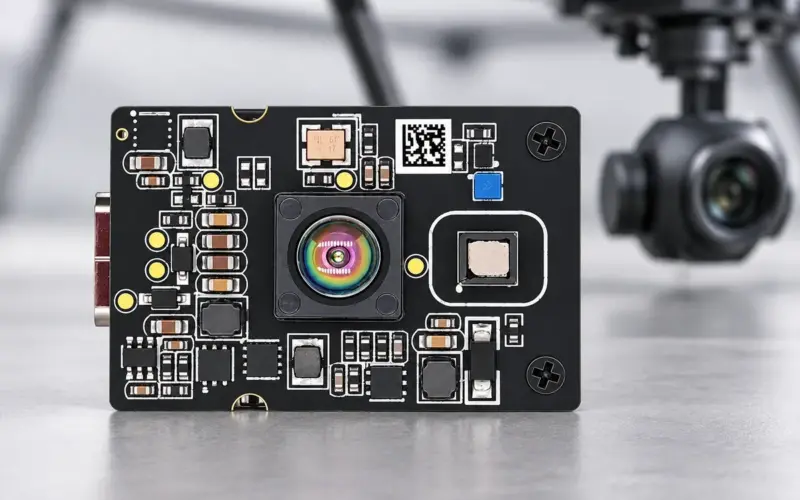
DMOM2508CL offers 320 × 240 MIPI depth at 940 nm over 0.2–2 m. DMOM2808D offers 320 × 240 MIPI depth at 850 nm over 0.25–4.5 m. Their compact optical heads are development inputs for a host-based design. Select wavelength, range and supply requirements together with the installed illumination tests.
Align depth with host perception
Calibrate camera intrinsics and the camera-to-cabin transform. Associate each frame with its timestamp and processing version. The host uses these measurements to segment zones, estimate features and produce the required cabin state.
If another camera supplies appearance or eye detail, establish its spatial and temporal relationship to depth. Choose an output validity and stale-data rule so downstream functions can distinguish a reliable state from an unavailable observation. Test model behavior on the actual occupant and seat configurations.
Evaluate sunlight, trim and occupant occlusion
Use direct and side sunlight, dark and reflective trim, glasses, clothing, hands near the face and moving occupants. Include left- and right-hand-drive layouts where relevant, child seats, varied seat positions and objects placed in the cabin. Track which task regions remain visible in each case.
Report geometric error, usable-observation coverage, task-specific errors and end-to-end timing separately. Repeat after optical and thermal changes, using independent reference observations for the output being evaluated.
Separate prototype selection from vehicle qualification
Select a prototype camera for its data, coverage and host integration, then define the production component and vehicle-validation path with the equipment developer. Environmental, reliability, optical, electrical and functional requirements belong to the intended vehicle installation and component scope.
Share cabin drawings, mounting locations, task outputs and the host platform with us. We can help establish a depth-capture evaluation configuration and the evidence needed for the next development stage.
Discuss your evaluation with DOMI.
FAQs
Which cabin tasks can use depth geometry?
Depth can provide inputs for occupied-zone, body-position and hand-location processing within the visible region. Each application needs its own algorithm, output definition and evaluation criteria.
How does depth differ from a 2D NIR image?
A NIR image records infrared appearance, while a depth map represents distance-related geometry. The chosen perception algorithm determines whether one or both inputs are useful.
What should a cabin coverage test include?
Include seat adjustment, occupant height, recline, child seats, trim occlusion and relevant body poses. Repeat under representative sunlight and installed optical conditions.
How is a development camera selected for a vehicle project?
Match its data route, range, field of view and host requirements to the prototype task, then define the separate component and vehicle qualification requirements for the intended production use.