
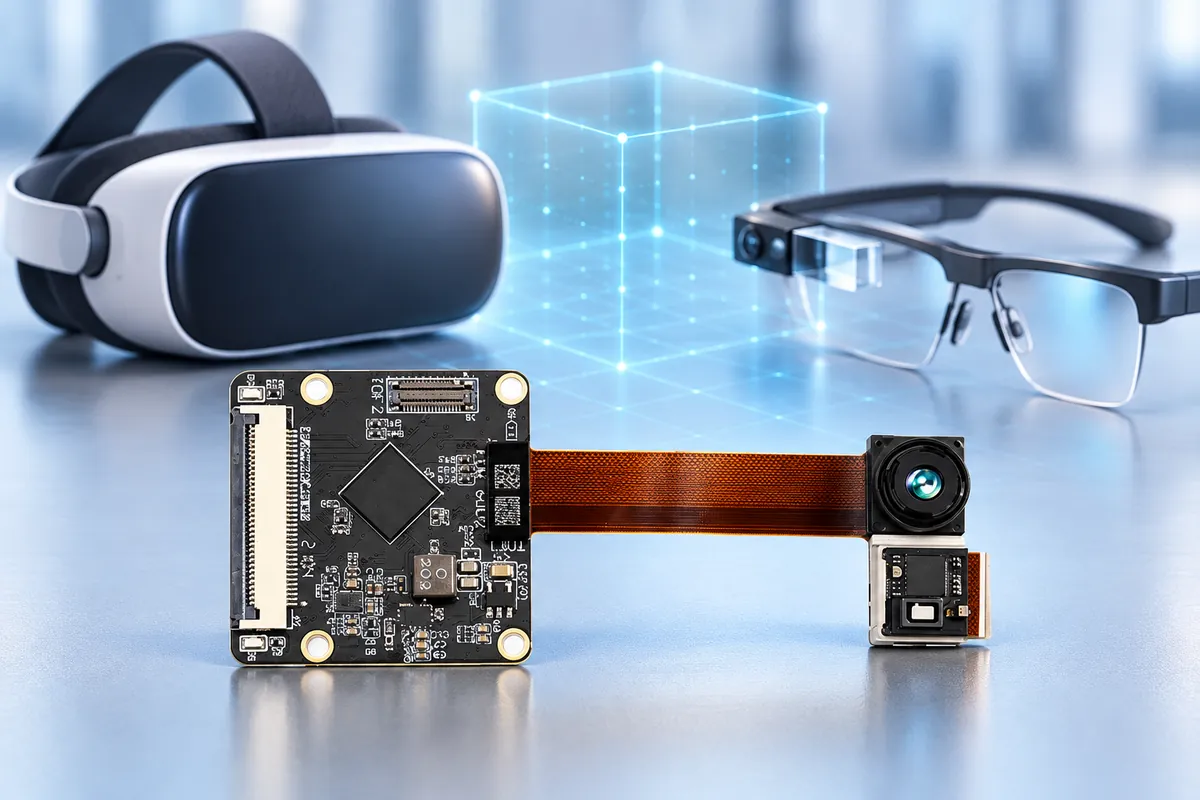
The best ToF sensor module for an AR/VR project fits the interaction area, supplies the data your software needs and works within your device's processing and installation budget. DOMI offers compact MIPI depth modules, modules with onboard depth processing, and USB RGB-D cameras for these different requirements.
For compact near-field hand interaction, start with DMOM2508CL. For defined sensing zones in an embedded XR peripheral, evaluate DMOS5030A/5031A. For a host application that uses color images together with depth geometry, choose the DM-RGBD5003A USB RGB-D route. Each recommendation below connects the project requirement to the module's specifications and the work needed on the host.
Recommended ToF modules by AR/VR project requirement
| Project requirement | DOMI option | Specification basis | Host integration |
|---|---|---|---|
| Compact depth input for near-field hand interaction | DMOM2508CL | 320 × 240 depth sensing; 0.2–2 m range; 21.00 × 9.50 × 6.33 mm module head | 2-lane MIPI CSI-2 capture with a host depth-processing and tracking pipeline |
| Defined interaction zones in an embedded XR peripheral | DMOS5030A/5031A | Onboard depth processing; output up to 100 × 100; 5030A: 0.2–4.8 m, 30° × 30° FOV; 5031A: 0.2–2.5 m, 60° × 60° FOV | Firmware-configurable UART or SPI communication for the selected output |
| RGB and depth input for spatial perception development | DM-RGBD5003A | VGA 640 × 480 ToF depth, RGB images and X/Y/Z point clouds; 0.2–5 m, indoor / semi-outdoor | USB 2.0 connection to host perception and interaction software |
Choose the required sensing volume and data output first. Usable distance and valid-data coverage depend on the target materials, lighting and final cover window. The selected firmware and output mode determine the actual data delivered over an interface.
DMOM2508CL for compact near-field hand interaction
DMOM2508CL provides 320 × 240 depth sensing through a 2-lane MIPI CSI-2 interface. Its 21.00 × 9.50 × 6.33 mm module head makes it a useful starting point when a compact embedded design needs spatial distance samples within a 0.2–2 m interaction region. Its field of view is 71.8° horizontal × 56.6° vertical.
We recommend this route when the device design includes an embedded MIPI receiver and host software for depth processing and hand interaction. Define the hand volume, smallest relevant movement and expected motion before choosing the mounting position. Depth samples provide input to the tracking software, while capture, processing and application updates determine the complete response.
Plan the carrier, capture driver, depth-processing stage and output format together. The sensor and VCSEL use separate power rails, so include both in the power and thermal design. Keep the lens and illumination paths clear of the enclosure and test the assembled optical stack.
DMOS5030A/5031A for embedded XR sensing zones
DMOS5030A and DMOS5031A combine ToF sensing with a DM3602 processor. The module processes sensor output before sending processed results through its firmware-configurable UART or SPI interface. We recommend evaluating this route for an XR peripheral with a defined sensing zone and a host that consumes the selected depth or application result.
Choose DMOS5030A when its 30° × 30° field of view covers the target region and the project needs the longer specified 0.2–4.8 m range. It uses 850 nm illumination. Choose DMOS5031A when wider 60° × 60° coverage is useful within its specified 0.2–2.5 m range. It uses 940 nm illumination.
Both variants support firmware-configurable output up to 100 × 100. Include the required result type, update rate and communication mode in the firmware discussion, then plan host parsing and buffering around that output. A defined sensing zone for an XR peripheral and a continuous hand-pose pipeline can require different data and processing.
DM-RGBD5003A for RGB-D spatial perception development
DM-RGBD5003A supplies RGB images, VGA ToF depth data and X/Y/Z point clouds through USB 2.0. We recommend the DM-RGBD5003A VGA ToF RGB-D Depth Camera when a host application uses visual appearance together with distance or three-dimensional coordinates for spatial perception, interaction development or scene measurements.
Its specified range is 0.2–5 m for indoor and semi-outdoor use. The camera measures 79 × 35 × 15.7 mm, so include its housing, mounting position, cable route, supply and heat dissipation in the prototype layout.
Choose the required streams before sizing host bandwidth and processing. Keep distance scale, calibration, coordinate conventions and capture timestamps with the data. Our RGB-D camera guide explains color-depth correspondence and the difference between spatial alignment and capture timing.
Match the interface to your AR/VR design
MIPI fits an embedded design that includes a receiver, capture driver and depth-processing pipeline. DMOM2508CL gives this design a compact sensing head. DMOS5030A/5031A move depth processing onto the module and provide the firmware-selected result through UART or SPI. DM-RGBD5003A provides a USB 2.0 route for host software using RGB, depth or point-cloud streams.
The interface choice follows the output your application needs. For hand interaction, define the tracking input and motion region. For an embedded peripheral, define the sensing zone and result type. For RGB-D perception, define the streams, coordinate system and timing your software consumes.
Choose an evaluation configuration
Measure capture, transport, processing and application-update timing in the assembled prototype using representative targets and motion. Check depth validity near the boundaries of the working volume as well as at its center. Our AR/VR integration guide covers system timing, pose association, optical installation and power planning.
Share your host processor, interaction region, required streams or results, expected update rate and installation space with us. We can help you shortlist a DOMI ToF module and discuss the matching evaluation configuration through our contact page.
FAQs
What is the best ToF sensor module for an AR/VR project?
For compact near-field depth input, start with DMOM2508CL and its 320 × 240 MIPI route. Evaluate DMOS5030A/5031A for a defined sensing zone with onboard depth processing and a selected UART or SPI output. Choose the DM-RGBD5003A USB RGB-D route when the host software needs color, depth or X/Y/Z point clouds. The best fit depends on the interaction region, required output and host architecture.
Which module should I evaluate for near-field hand interaction?
DMOM2508CL provides a compact 320 × 240 MIPI route with a specified 0.2–2 m working range. Define the hand volume and tracking-software input, then test the final optics, motion and host pipeline in that region.
How do DMOS5030A and DMOS5031A differ?
DMOS5030A uses 850 nm illumination, a 30° × 30° field of view and a specified 0.2–4.8 m range. DMOS5031A uses 940 nm illumination, a 60° × 60° field of view and a specified 0.2–2.5 m range. Both use onboard depth processing and a firmware-configurable UART or SPI host interface.
What should I provide when discussing an AR/VR evaluation?
Provide the host platform, interaction region, target materials, expected motion, lighting, required data output and installation space. Include your update-rate or response-time requirement so that the capture, processing and application stages can be planned together.