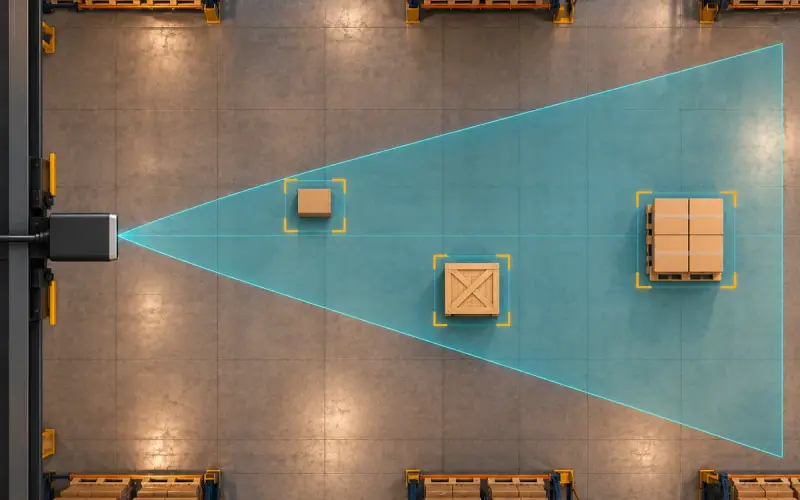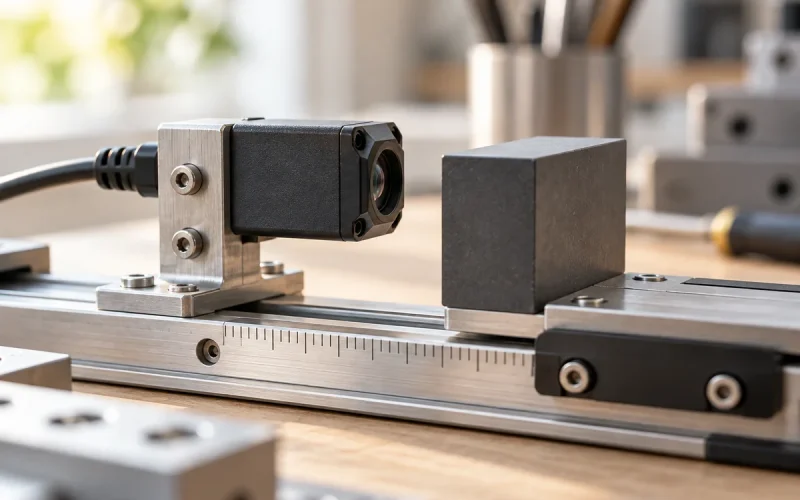

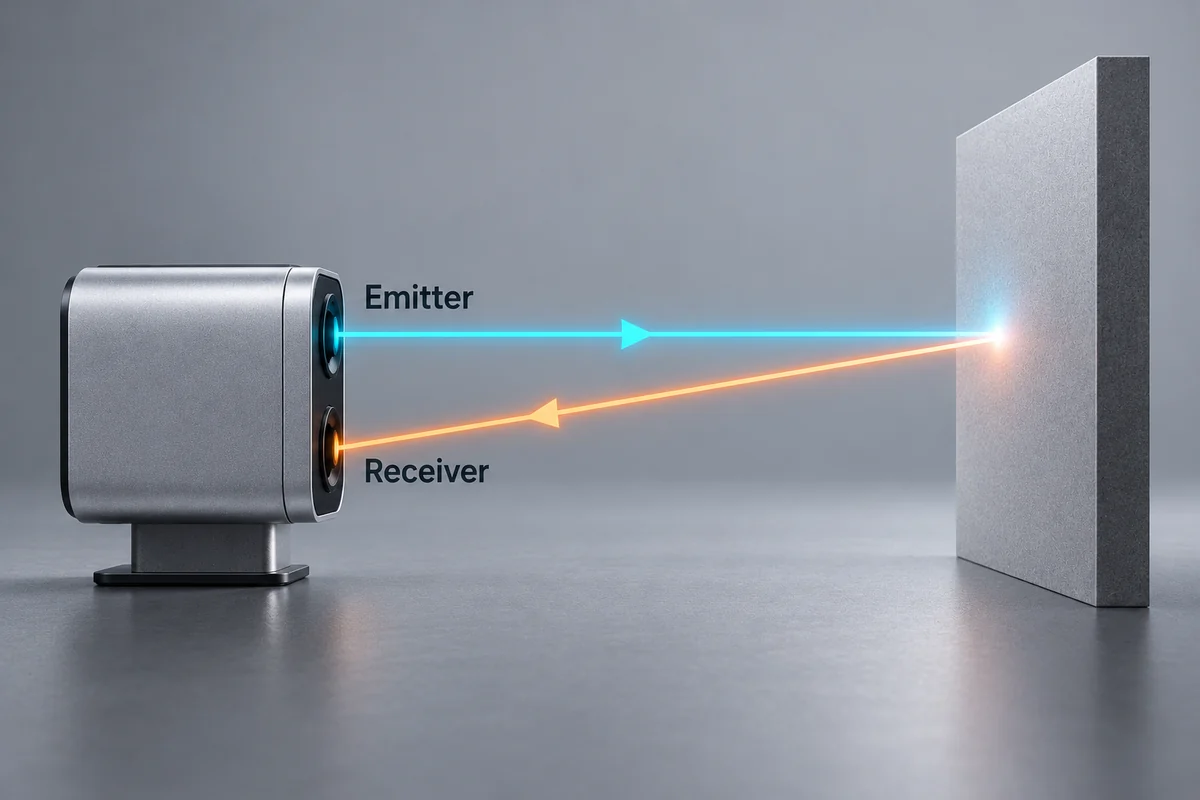
A Time-of-Flight, or ToF, camera measures spatial distance using light emitted toward a scene and returned to its receiver. It produces a depth image across many locations, giving software geometric information about the surfaces in view.
A ToF depth camera can support tasks such as locating surfaces around a robot, examining parcel geometry or measuring activity in a defined region. The depth data becomes an input to the software that performs the application task.
How does a ToF camera measure distance?
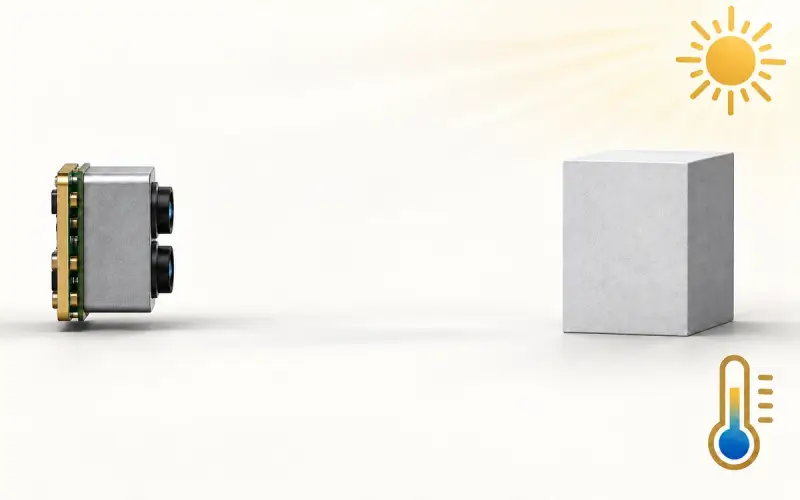
The camera illuminates the scene with pulsed or modulated light. Its receiver collects returned light, and processing estimates the travel delay. Direct ToF measures timing associated with the return; phase-based indirect ToF estimates delay from the relationship between emitted and received modulation.
For an ideal round trip, time-of-flight distance measurement follows d = c × Δt / 2. The signal travels to the surface and back, so the round-trip path is divided by two. Practical cameras apply their timing, processing and calibration methods to obtain useful measurements from noisy signals.
The dToF vs iToF guide explains the measurement routes and why they should be compared at product level.
A simple Time-of-Flight distance calculation
In the ideal round-trip model, distance = c × round-trip delay / 2. Using an approximate light speed of 300,000,000 m/s, a 10 ns return delay corresponds to 1.5 m. The factor of two accounts for light traveling to the target and back. This is an arithmetic illustration of Time-of-Flight distance measurement, not a camera accuracy specification.
A real depth frame combines detection, estimation, calibration and processing. An iToF camera obtains the delay indirectly from modulation; a dToF design uses its timing method. The dToF vs iToF comparison explains that distinction. For a camera shortlist, move from this working principle to the range, coverage and integration requirements of your application.
What information does the camera produce?
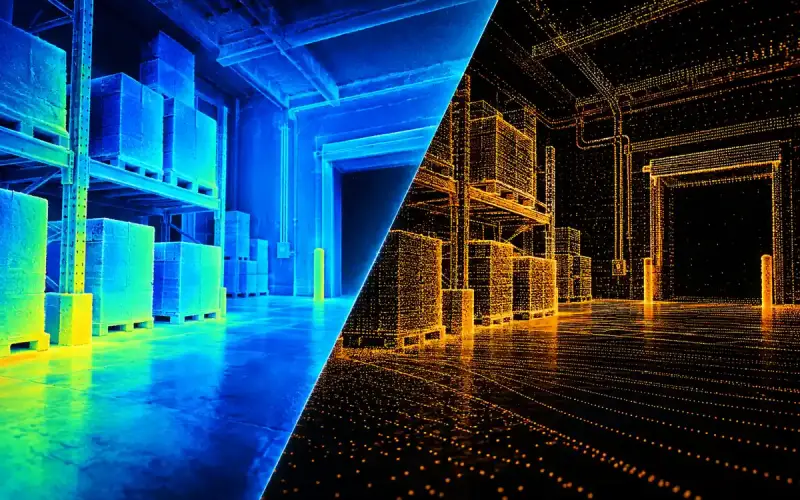
A depth image associates measurement values with image locations. The device and software define the units, scale, invalid values and whether the output describes radial distance or Z depth. A display can map these values to shades or colors for inspection.
A point cloud expresses spatial samples as coordinates. It can be supplied by a product or calculated from supported depth output and camera calibration. Read depth map vs point cloud when planning the host data path.
ToF camera, ranging sensor and RGB-D camera
| Product description | Information to expect and review |
|---|---|
| Single-point ToF ranging sensor | A distance measurement for a defined sensing region |
| Multi-zone or array ToF device | Spatially separated ranges, with detail determined by the device |
| ToF depth camera | Depth information across an imaging field of view |
| RGB-D camera | Color and depth streams, with model-specific geometry and timing |
RGB-D describes the combination of data streams. A system can obtain its depth through ToF, stereo or another measurement route. The RGB-D depth guide explains that distinction.
Where ToF depth information is useful
Depth can help distinguish foreground from background by distance, identify surfaces for geometric calculations and describe the space an object occupies. Robotics, logistics and interaction systems can use those measurements in their processing pipelines.
Specify the decision the software must make before choosing a camera. A single trigger distance may suit a ranging sensor. A task involving object boundaries or several surfaces can benefit from a depth image with suitable field of view and spatial detail.
What affects a ToF measurement?
The target's reflectivity, size and angle affect the return reaching the camera. Ambient light, other active devices, multiple reflections and a protective optical window can also affect useful data. Evaluate the same materials and installation conditions planned for the application.
Working distance, coverage, acquisition timing and host processing belong in the selection together. Use the ToF camera selection guide to turn those requirements into an evaluation plan, or explore DOMI's ToF camera modules.
FAQs
Can a ToF camera measure in darkness?
Active illumination lets a suitable ToF camera measure without visible room lighting within its operating conditions. Target return, range, optics and acquisition settings still determine the useful depth data.
Is a ToF camera the same as a laser scanner?
ToF describes a measurement method. A scanner and an imaging camera can use different ways to cover a scene and generate spatial samples. Compare the actual field of view, acquisition arrangement and output required by the application.
How do I choose a ToF camera for an application?
Define the target, working distances, scene coverage, spatial detail and timing. Include the host platform and installation conditions. Contact DOMI with those requirements for help narrowing the product options.