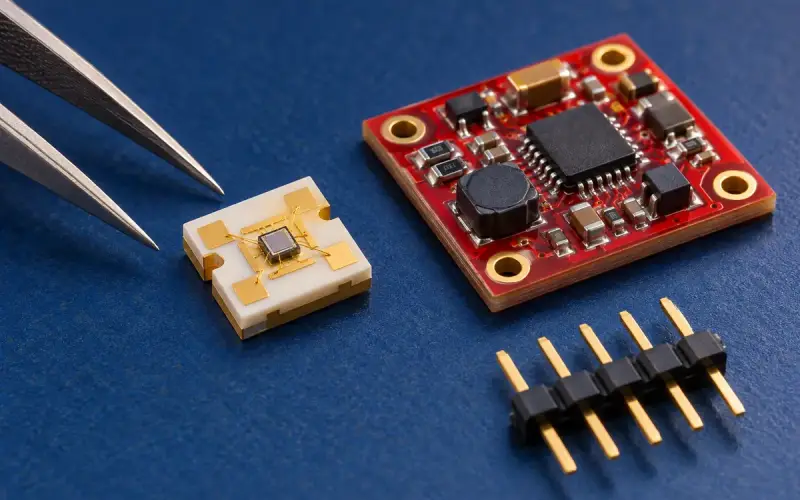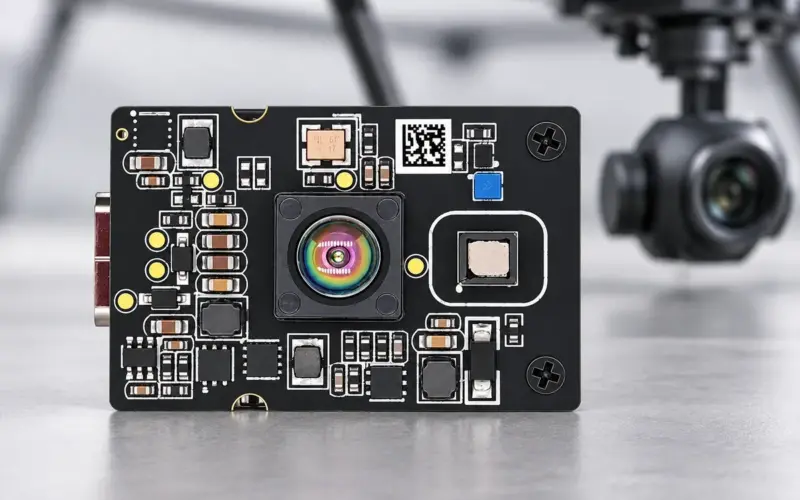

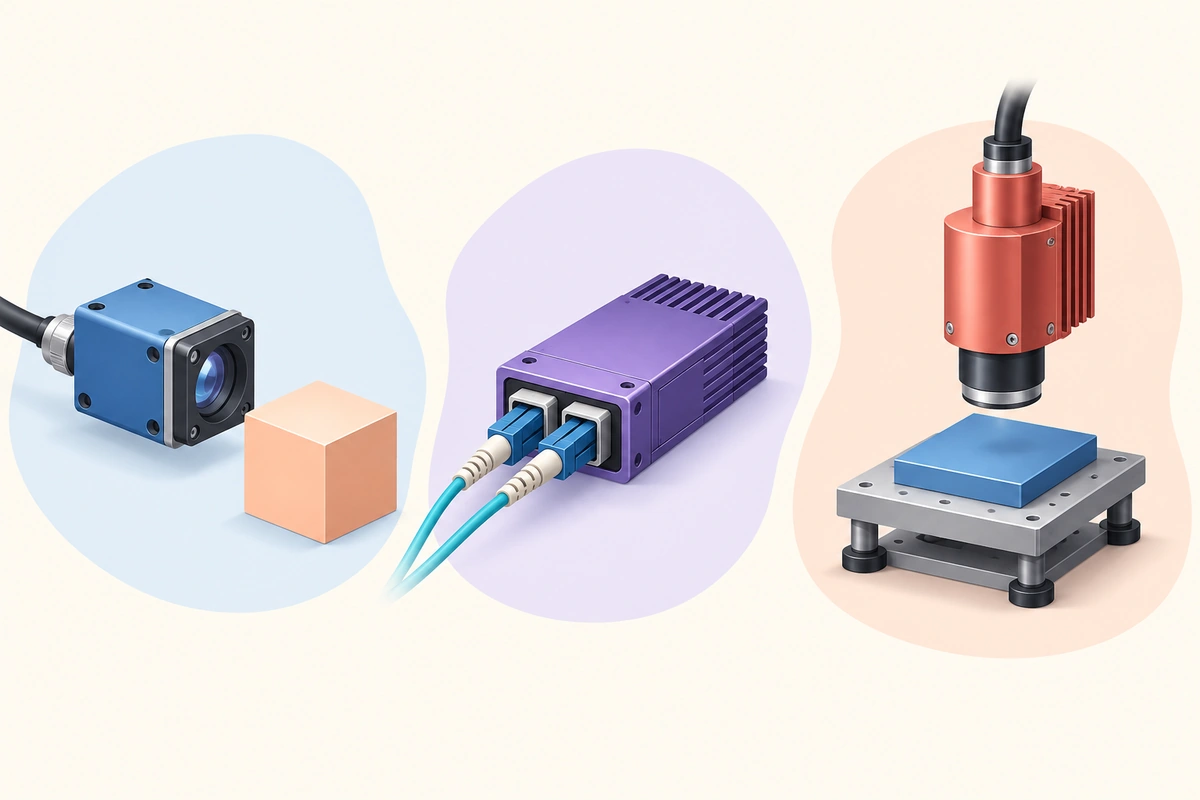
VCSELs are semiconductor lasers used in application-specific optical designs. Sensing, data communication and industrial heating place different demands on wavelength, modulation, beam geometry and thermal management. Choose the application and operating mode before comparing output-power figures.
Map sensing, datacom and industrial uses
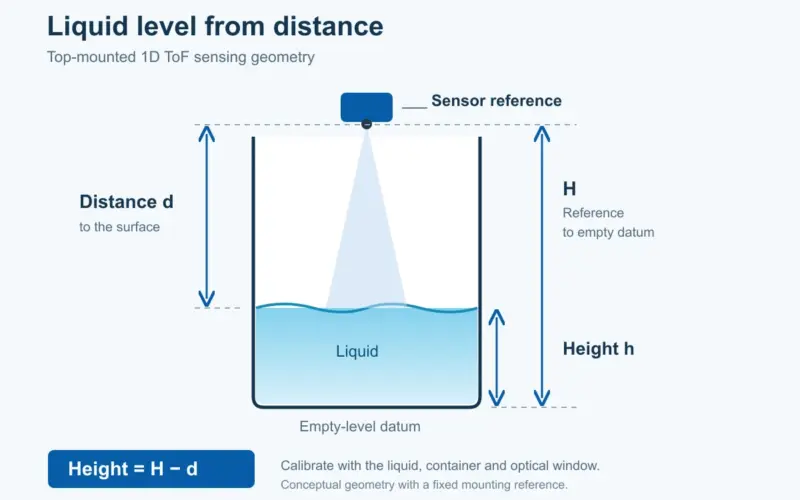
In depth sensing, a VCSEL supplies illumination to a system that measures or interprets returned light. Depending on the architecture, that may involve timed pulses, modulation or a projected pattern. The receiver and processing chain determine how the illumination becomes a useful measurement.
Datacom designs need an emitter suited to their modulation, coupling and link requirements. Industrial thermal processes instead evaluate delivered energy, illuminated area, temperature uniformity and process control. A device intended for one of these uses should be assessed against the full requirements before considering another.
Match wavelength and spectral requirements
Choose wavelength with the receiving sensor, optical filters, target response and application material. Record the wavelength tolerance and temperature conditions of the selected device. Applications using a specific absorption feature also require suitable spectral behavior, which is a separate requirement from being a VCSEL.
DOMI's DMP300KP and DMP1KKM provide 905 nm pulsed-emitter routes. DMP200W is a 980 nm water-cooled continuous-wave module. Their wavelength and operating-mode differences should remain visible in the selection record.
Choose emission mode, pulse and beam geometry
For pulsed sensing, define pulse width, repetition rate, current waveform, channel timing and receiver relationship. For continuous-wave operation, define sustained optical output, electrical load and cooling. Beam divergence, emission area, array layout and downstream optics determine how light reaches the target.
A patterned illumination assembly, a focused data link and a heated work area require different optical designs. Product names and nominal power alone do not establish the necessary beam or modulation behavior.
Separate optical power, electrical load and thermal design
Optical power is emitted light. Electrical power is supplied to the device and driver. Their difference contributes to the thermal-management problem, together with losses elsewhere in the assembly. Compare values at the same stated operating point and temperature.
For pulsed devices, retain pulse width and duty cycle alongside peak power. For a CW module, evaluate sustained conditions and cooling rather than treating its optical rating as a short-pulse specification. Use measured waveforms or controlled operating records for energy calculations.
Select a DOMI illumination route
| Product route | Documented operating example | Application-selection focus |
|---|---|---|
| DMP300KP | 300 W typical pulsed optical power at 61 A, 5 ns, 0.025% duty, 25°C substrate temperature | 905 nm pulsed illumination, driver, receiver and thermal coordination |
| DMP1KKM | Per-channel 70 W typical, 40 W minimum at 15 A, 1.5–2 ns, 0.03% duty, 25°C | 16-channel 905 nm array layout and channel operation |
| DMP200W | 980 nm CW module with a documented 200 W optical operating point at 25°C case temperature | Sustained optical delivery, electrical supply and water cooling |
DMP200W also has a documented 30 W operating point; two test points do not define a qualified continuous adjustment range. At the 200 W point, its listed typical current and voltage are 20 A and 45 V. Its cooling-water specification is 15–25°C at a flow of at least 10 L/min. Keep the CW operating and cooling conditions together when evaluating the assembly.
Know when another VCSEL design is required
High-speed communications, wavelength-selective sensing and other specialized uses need devices documented for their own optical and electrical demands. The DOMI routes above address their stated emitter configurations; assess another design when the application requires a different wavelength, spectral behavior, modulation or coupling arrangement.
For gas sensing, the selected absorption feature determines the wavelength and spectral requirements. For laser printing, the optical scanning arrangement, modulation and spot requirements belong to the print engine. Evaluate those designs with application-specific component evidence rather than extending an illumination module's rating to them.
Send us the application, wavelength, beam geometry, mode, optical output and thermal constraints. For timed ranging, the dToF LiDAR emitter guide explains the transmitter-receiver relationship and pulse-power conventions.
Discuss your evaluation with DOMI.
FAQs
Can one VCSEL type serve sensing, datacom and heating?
These applications have different wavelength, modulation, beam and thermal requirements. Select a device documented for the required operating mode and optical arrangement.
How should pulsed and CW optical power be compared?
Keep peak power, pulse energy, duty cycle and average output separate for pulsed operation. CW power describes sustained output under its stated electrical and thermal conditions.
Is DMP200W a pulsed LiDAR emitter?
DMP200W is the 980 nm water-cooled CW route described here. DMP300KP and DMP1KKM are the listed 905 nm pulsed-emitter routes for evaluation with a timed sensing architecture.
Which requirements should be sent for VCSEL selection?
Provide wavelength and tolerance, pulsed or CW mode, required optical output, beam geometry, driver arrangement and cooling constraints. Add receiver and channel-timing requirements for a sensing system.