
A ToF camera can measure the visible surface of material inside a near-field bin, hopper or small pile. Software relates that surface to reference geometry and integrates the height over an area. Define the measurement as bulk volume, fill level or another output before selecting the camera and calculation method.
Define a near-field bin, hopper or small pile
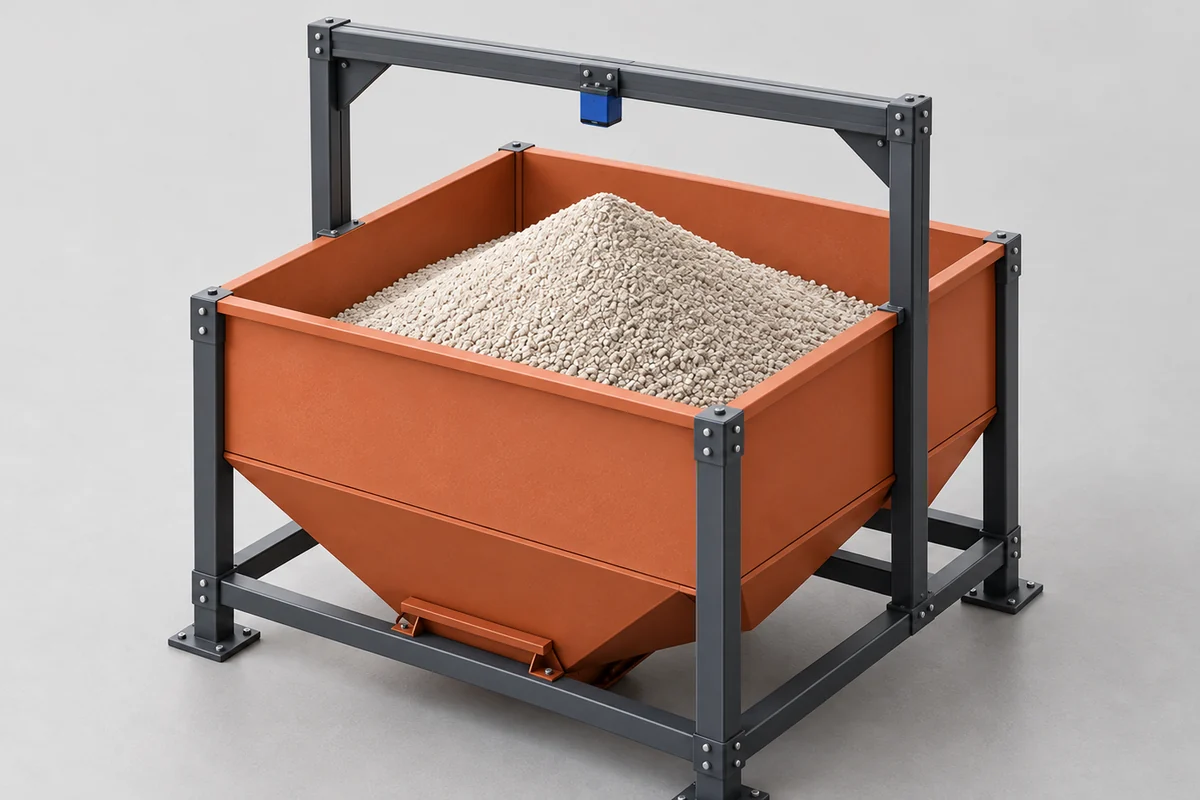
Specify the vessel dimensions, camera-to-surface distances from empty to full, maximum pile slope and material properties. Check whether the rim, support frame or central filling stream blocks the view. The camera must observe the required surface throughout the fill cycle.
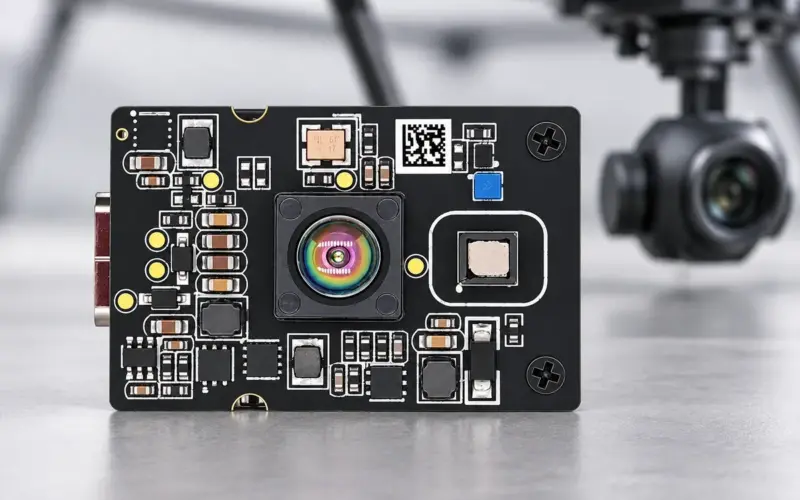
DM-RGBD5003A offers 640 × 480 depth over 0.2–5 m for indoor/semi-outdoor installations. DMOM2808D offers a 320 × 240, 850 nm MIPI route over 0.25–4.5 m. These are starting points for nearby geometry; the vessel layout and material tests determine usable coverage.
Capture empty-bin or ground reference geometry
Calibrate intrinsics and the installed camera pose. Capture the empty vessel, or use a surveyed vessel model, so the host can relate each visible surface point to the correct base elevation. A flat reference plane is suitable only when it represents the actual base or the chosen measurement datum.
Transform points into a vessel coordinate system with a defined vertical axis. Mask walls and fittings that should not count as material. Keep a reference record for the mounting pose and recheck it after maintenance or movement.
Estimate surface height on a common grid
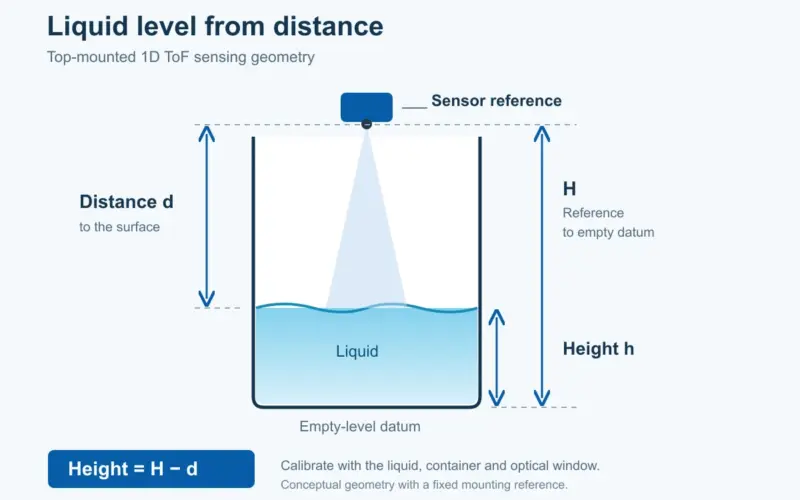
Project valid points onto a horizontal grid and calculate material height above the reference base in each observed cell. Preserve a validity mask. A missing return is an unknown area, so record it separately from a measured empty cell.
A single-point level measurement samples one location. An area depth measurement can represent an uneven surface over its visible region. Peak height, average height, fill percentage and bulk volume describe different quantities and should have separate output definitions.
Integrate height over the visible area
For a vertical-sided region with a height-field surface, estimate volume using V = Σ(h_i × A_i), where h_i is the material height above the local base and A_i is the horizontal cell area. A tapered vessel requires its real geometry; multiplying one level by the top opening area would misrepresent its volume.
For an illustrative fully observed flat-base region of 0.8 m² with a mean height of 0.25 m, the integrated volume is 0.20 m³, or 200 L. This is a geometry example, not a camera accuracy result. Bulk volume includes spaces between particles. Converting it to mass requires an appropriate bulk-density model and its own uncertainty assessment.
Handle occluded regions, dust and missing returns
Report observed area and unknown area alongside volume. An estimate that interpolates across a gap should identify that rule and be checked against representative pile shapes. A second view may improve coverage, with overlap registration and timing included in the system design.
Test dust during loading, dark material, shiny particles, slopes and changing ambient light. Compare empty, settled and actively filling states. Filtering can reduce temporal variation but can also delay a fill-change report, so measure its effect on the intended control task.
Compare estimates against a reference volume
Use controlled fills or a reference survey covering the vessel's working range. Report signed error, absolute error, repeatability and visible-area coverage by fill level and material. Keep the reference method's uncertainty separate from the depth system's observed error.
Send us the vessel drawing, mounting position, material samples and required output to plan a test. For parcel length, width and height, use the separate parcel-dimensioning method; a bounding box and an integrated bulk surface answer different questions.
Discuss your evaluation with DOMI.
FAQs
Is fill level the same as volume?
Fill level is a height at a defined position or under a stated averaging rule. Volume integrates material over the vessel geometry. Uneven surfaces and tapered walls make the distinction important.
Does a bulk-volume estimate give the solid volume of the particles?
It describes the bulk region under the measured surface, including inter-particle voids. Solid volume or mass needs additional material information and a separately validated conversion.
What should the output show when part of the pile is hidden?
Report the unknown area and the estimation rule used there. Check any interpolation or additional-view method against reference fills instead of silently treating missing points as empty space.
How can DOMI help with a bin application?
Share empty-to-full distances, opening size, material surfaces, dust conditions, host interface and required volume tolerance. We can use these inputs to select a camera route for evaluation.