
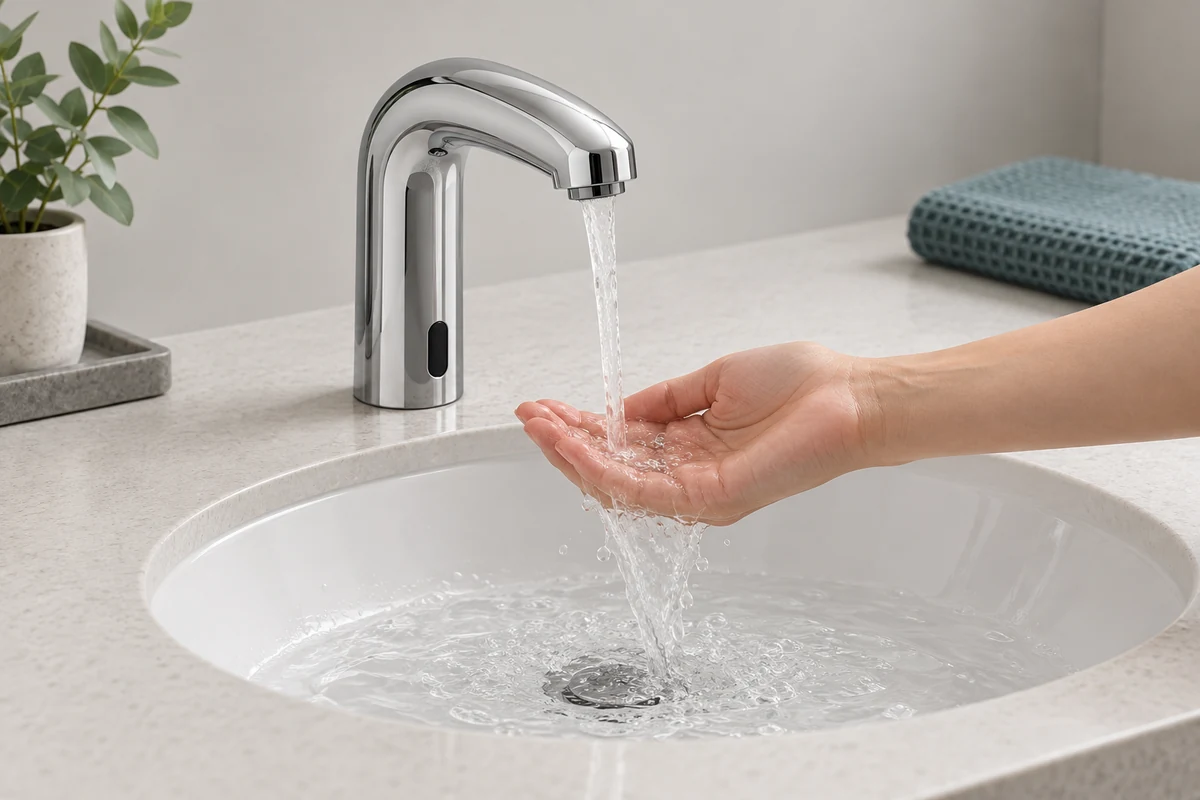
ToF proximity sensing can provide a distance-based input for a touchless tap, mirror or sanitary fixture. Define the target zone and activation behavior, then choose a point or area sensor for the required geometry. The installed optical path and control logic deserve particular attention in a wet environment.
Define hand, approach and seated-presence zones
A hand-triggered tap needs a local hand region near the outlet. An approach feature for a mirror observes a person in front of the fixture. A seated-presence feature uses a different region and observation period. Treat these as separate functions with independent activation and release conditions.
A touchless soap dispenser can use a similar local hand-detection input, with dispensing duration, release and repeat limits defined for its own actuator. Test the hand region relative to the nozzle and basin rather than copying a tap's thresholds unchanged.
Fixture presence is also different from whole-room occupancy. Use the occupancy-monitoring guide for room-state observation and blind-zone planning. Choose which information the product actually needs before collecting a broader scene.
Match distance and FOV to the fixture
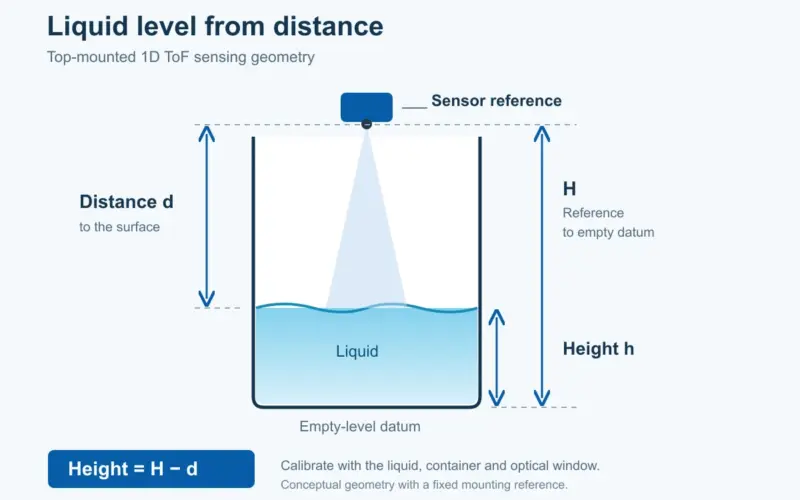
Draw the sensor view relative to the basin, outlet, seat, wall and expected user positions. Check the near-field region and whether a reflective fitting or water stream lies in the view. A point distance suits a compact trigger zone when its measured target is unambiguous; area data can support multiple regions when the host needs them.
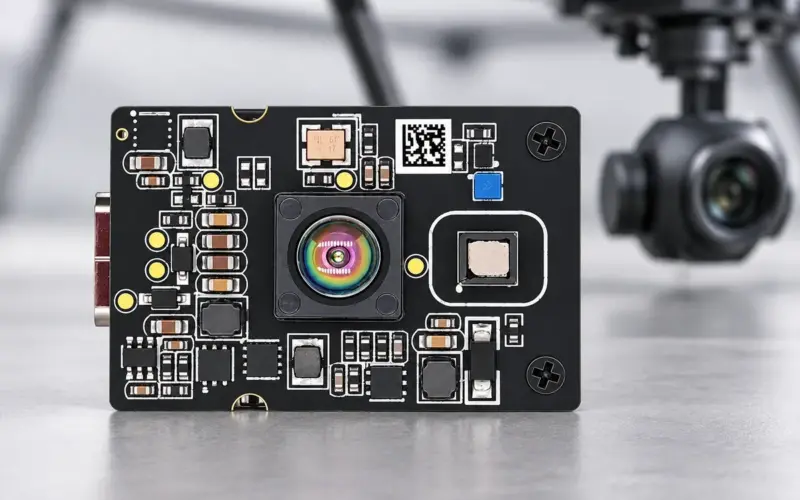
DM0301 offers single-zone processed distance through I²C. DMOS5030A/5031A offers onboard processing with up to 100 × 100 depth sampling. DMOS5030A has a 30° × 30° field of view and 0.2–4.8 m range; DMOS5031A has a 60° × 60° field of view and 0.2–2.5 m range. Match the selected model's near distance and footprint to the actual fixture.
Design trigger, hysteresis and release states
Define idle, candidate, active and release states. Require the target to persist long enough to qualify, use separate activation and release thresholds where helpful, and set a maximum active duration. Decide how the controller behaves when a hand pauses, moves sideways or is replaced by another object.
Treat invalid or stale measurements explicitly. Coordinate the sensing state with the valve, display or other controlled function, including startup and interruption behavior. Distance-based triggering and gesture classification are different tasks; a gesture function needs a defined motion sequence and its own processing tests.
Handle droplets, steam and reflective surfaces
Test a clean dry window, isolated droplets, a water film, condensation and the expected steam conditions. Include polished fittings, mirrors, dark clothing and the running water stream. Changes in the optical path can alter returns or reduce valid measurements, so preserve a usable-data indicator in the host logic.
Evaluate the cover material at the operating wavelength and the installed thickness and spacing. Limit coupling between emitter and receiver through the cover and enclosure. Sealing and water protection must be designed and assessed for the complete fixture assembly.
Validate cleaning, enclosure and false activations
Use representative cleaning methods and residues, and repeat measurements after the optical surface is cleaned. Measure wanted activations, false activations per observation period, release timing and behavior during invalid-data intervals. Test users and movements across the intended zone, including adjacent activity that should not trigger it.
Choose data handling alongside the function. A local distance threshold may need only a state value; an area algorithm may process more detailed depth. Define what is stored, transmitted and accessible rather than deriving a privacy conclusion from the sensor type.
Send us the fixture drawing, near and far target positions, cover design, host interface and activation sequence. We can help select a sensing route and a repeatable wet-environment evaluation.
Discuss your evaluation with DOMI.
FAQs
Which bathroom functions can use proximity measurements?
Distance-based hand, approach or seated-presence triggers are possible input tasks. Each needs a defined zone, control sequence and evaluation in the intended fixture geometry.
How can false triggering near a threshold be reduced?
Use suitable persistence, activation and release thresholds, region selection and timeout logic. Evaluate those settings with wanted movements, adjacent traffic and changes in the optical surface.
What wet-environment tests matter?
Test droplets, films, condensation, steam, running water and reflective fittings, as well as cleaning residues. Check valid data and final activation behavior with the complete enclosure.
What data should a fixture retain?
Retain the information needed for its defined function under a documented access and retention policy. A local state-based controller may need less retained detail than an application processing full depth frames.