
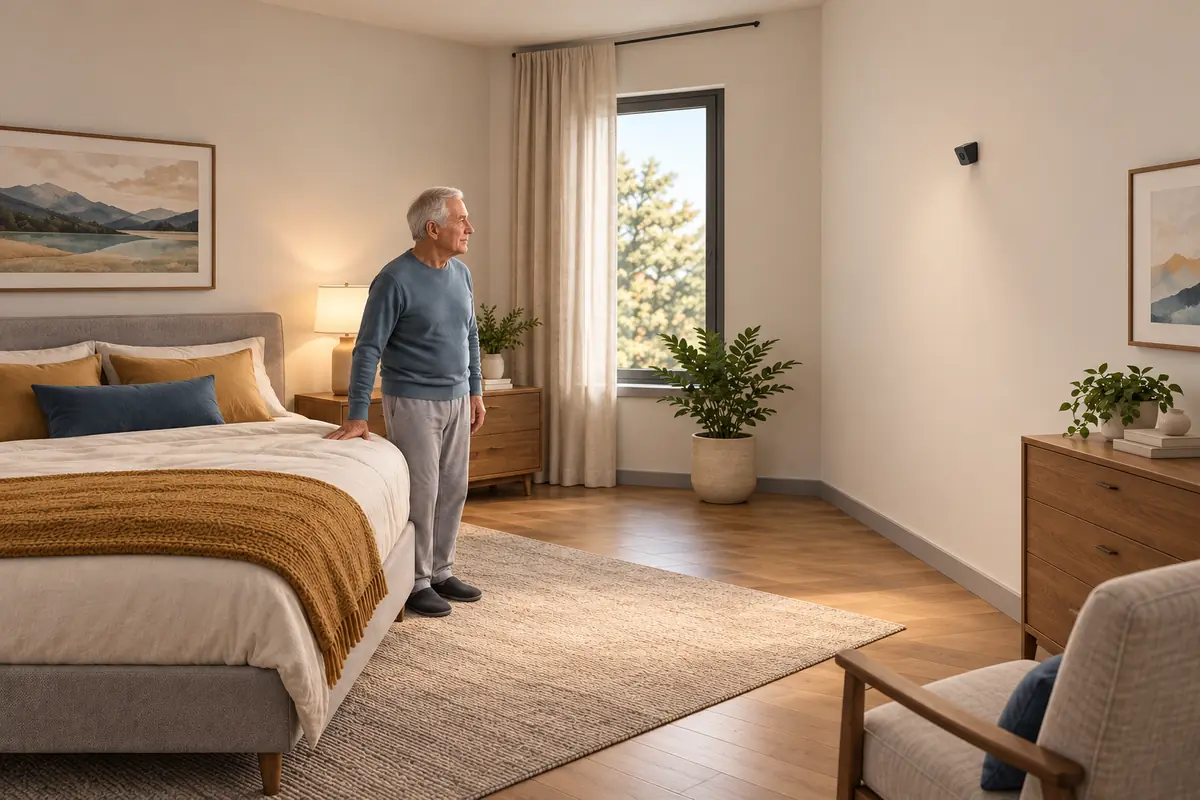
Depth sensing gives a care-monitoring application room geometry, body-height changes and movement observations without requiring a wearable for those observations. An elderly-care system combines that input with event-processing software and a caregiver response workflow. Start with the events to report and the spaces in which they can be observed.
Define fall, bed-exit and activity events
Write separate definitions for a fall candidate, leaving a bed, entering a selected zone and a period of limited activity. A fall algorithm may use posture, height change and a temporal sequence. A low point alone can also represent sitting, kneeling or reaching for an object.
Bed-exit monitoring needs a bed region, an occupied state and a defined transition out of it. Activity summaries need a time window and clear observed quantities, such as zone transitions. Map each event to an appropriate caregiver action and a rule for acknowledging or dismissing it.
Plan room coverage and mounting
Draw the room, bed, chair, doorway and furniture against the sensor view. Check camera-to-person distances at the floor, seated and standing positions. Blankets, furniture and another person can conceal body regions; define which parts of the event remain observable in those conditions.
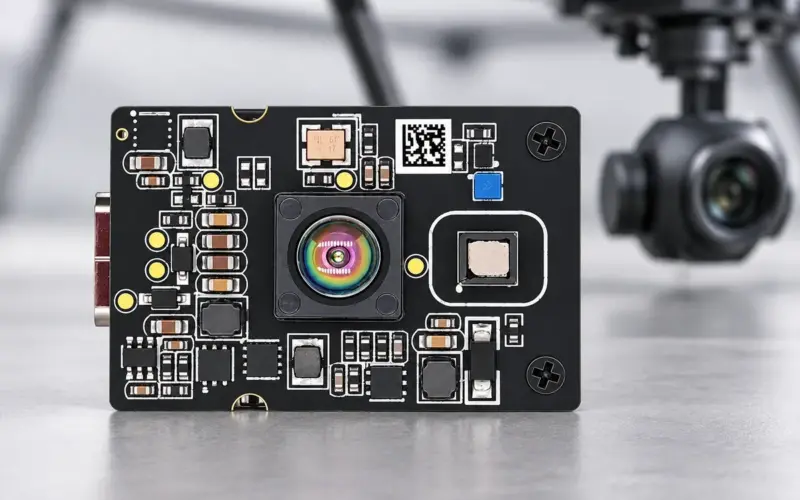
DMAS2M001 offers a 60° × 45° field of view with 40 × 30 depth sampling. Its 0.2–8 m range is specified at 10%–90% reflectivity and 30 klux. DMOM2508CL covers 0.2–2 m at 320 × 240 for a nearby MIPI installation, and DMOM2808D covers 0.25–4.5 m at 320 × 240. Choose coverage according to the room geometry and algorithm's input needs.
Build depth, posture and event processing
The host converts calibrated measurements to a room coordinate frame, separates relevant regions, estimates posture or movement features and applies event logic over time. Define invalid-data behavior and track when a person leaves the usable view. DMOS5030A/5031A offers another onboard-processing route whose selected firmware outputs should be matched to the application.
For nighttime use, test the complete installation in the intended illumination, including adjacent infrared devices and partially covered occupants. Distinguish body/activity observations from physiological measurements. The event system should use only outputs that have been defined and evaluated for its configuration.
Collect falls and ordinary activities separately
Build a labeled evaluation set with both event examples and everyday activities, including sitting quickly, bending, kneeling, lying down intentionally and picking up objects. Use safe, controlled simulations or appropriate professional test protocols; vulnerable users should not be asked to perform dangerous falls for a sensor test.
Keep training and evaluation sequences separate. Record room layout, mounting, participants or test surrogates, occlusion and illumination for each sequence. Test the final event thresholds on scenarios beyond those used to tune them.
Measure missed events, false alarms and response delay
Report missed events against the labeled event count and false alarms against monitoring time, such as alarms per monitored hour. Separate event-detection delay from notification delivery and caregiver acknowledgement. State how ambiguous labels and periods without usable observations are handled.
Repeat tests for bed position, furniture changes, visitor activity and expected mobility aids. A single aggregate percentage can hide a scenario in which an event is often missed, so review results by event and room condition.
Design alert handling and data access
Specify who receives each event, delivery confirmation, escalation timing, acknowledgement and recovery after network or power loss. A reminder or cognitive-assistance function belongs to this application workflow, with its own user and caregiver requirements.
Choose whether to retain raw depth, event clips, derived posture or only event records, with access and retention policies for each. Send us room drawings, mounting constraints, event definitions and host requirements to discuss a depth-sensing evaluation.
Discuss your evaluation with DOMI.
FAQs
What does the ToF sensor contribute to fall monitoring?
It contributes depth and spatial changes within its visible region. The host estimates relevant features, evaluates the event sequence and passes a result to the alert workflow.
How should ordinary activities be tested?
Include sitting, bending, kneeling, intentional lying down and object retrieval as separate labeled examples. Compare their results with the defined fall and bed-exit events under representative room conditions.
Which timing measures matter for an alert?
Measure observation-to-event delay, notification delivery and caregiver acknowledgement separately. This shows where time is spent across the sensing and response chain.
What helps select a care-monitoring camera?
Provide the room layout, observable events, near and far body positions, occlusion conditions, host processing and desired retained data. These inputs define the camera coverage and evaluation plan.