
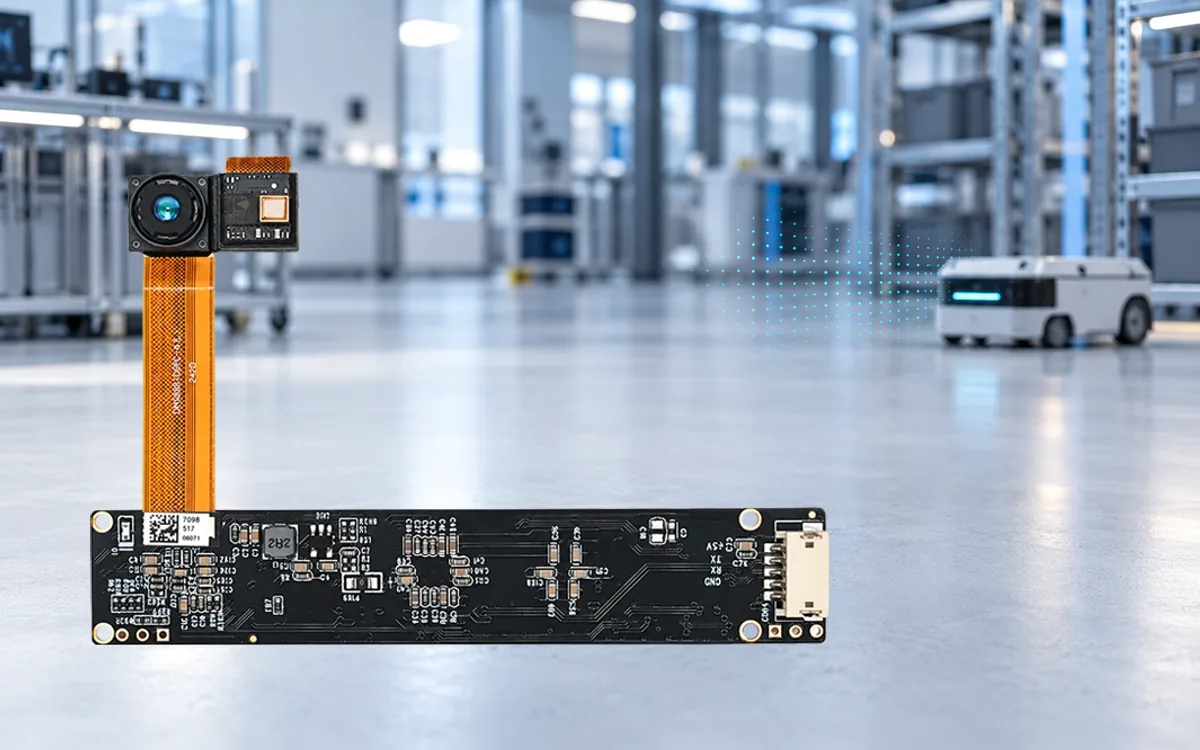
DOMI introduces DM5005A for teams building depth-sensing capabilities into robots, measurement equipment and interactive devices. The camera combines 320 × 240 ToF sensing with USB 2.0 and UVC 1.2 connectivity, providing depth, infrared and point-cloud data for host-based application development.
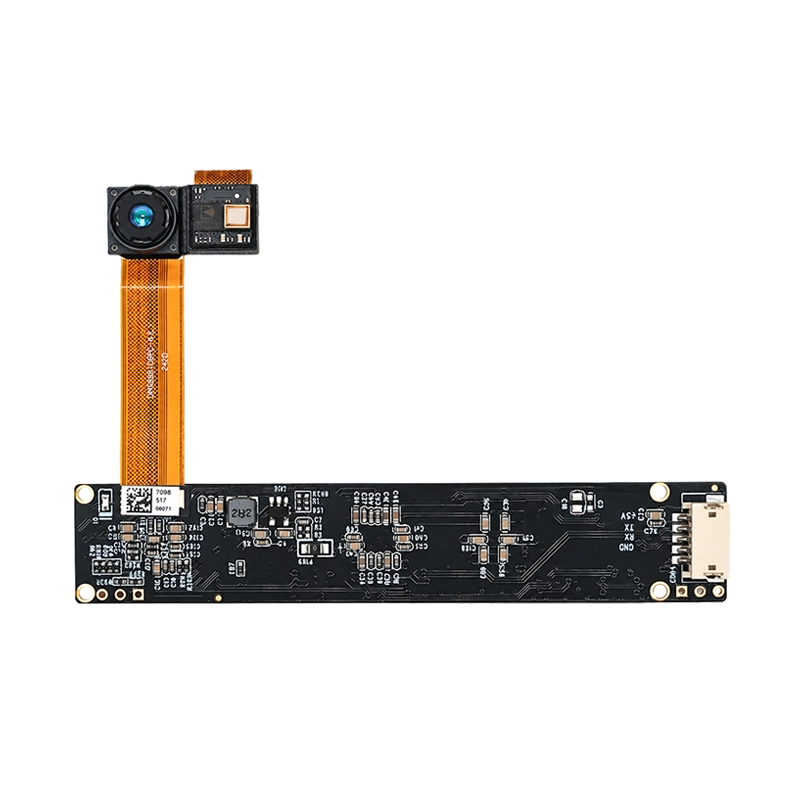
DM5005A pairs a QVGA MIPI depth module with a SigmaStar processing platform. With two wavelength configurations and a board-level design for customer-defined enclosures, it gives OEM teams options for matching the sensing area and mechanical assembly to their equipment.
What DM5005A brings to your design
Spatial data for perception and geometry processing
Depth maps describe distances across the observed scene, while point-cloud data gives application software a geometric representation to work with. Infrared images provide another image input for scene analysis. These outputs support development around object location, surface shape and spatial interaction.
The camera supports up to 30 fps at QVGA resolution. Developers can use successive frames to examine changes in the scene while building their perception or measurement workflow.
Two configurations for different working distances
The 940 nm version has a specified working range of 0.2–2 m, while the 850 nm version covers 0.3–5 m. This choice lets teams select the camera configuration around the distance between the mounting position and the area they need to observe.
For a nearby interaction zone, the shorter-range configuration is an option to evaluate. Projects observing objects farther from the camera can consider the 850 nm version. Both have a 70° horizontal × 50° vertical field of view, which helps define the sensing area together with the installation distance.
USB connectivity for host-based development
DM5005A connects to the host through Micro USB using USB 2.0 and UVC 1.2. The camera’s depth module and processing board provide a USB route for acquiring data while the host runs the project-specific perception, measurement or interaction software.
This architecture suits teams organizing their vision application around a host computer. The required data outputs and host platform guide the software integration discussion with our team.
Mechanical integration around your equipment
The 90.7 × 17.2 mm main board allows OEM teams to plan the enclosure and heatsink around their own device. Mounting points, optical openings, connector access and the thermal path can be considered together during the mechanical design.
For equipment with a defined front panel or internal layout, this provides flexibility in how the camera assembly is incorporated. The receive lens and illumination path should remain clear, with space reserved for the USB connection and cooling.
Where these capabilities fit
Robot perception and object localization
A robot’s perception software needs spatial information about the objects around it. DM5005A depth and point-cloud outputs can serve as inputs for locating objects, examining nearby obstacles and developing manipulation workflows.
For a mobile platform observing the area ahead, camera orientation and working distance determine which region is captured. For a robot observing a presented part, the same planning starts with the part’s position and size. The wavelength options and field of view help teams arrange the camera for the region their software needs to analyze.
3D measurement and shape capture
Depth maps and point-cloud coordinates provide surface geometry for reconstruction and dimensioning software. A measurement workflow can use these inputs to examine object shape and calculate dimensions after the camera setup and processing have been calibrated for the task.
The target size, mounting distance and measurement region guide camera placement. DM5005A offers a USB-connected source of geometry data for teams developing that workflow, with the complete measurement result established through their application software and calibration.
Gesture and spatial interaction
Interactive equipment can use distance information to define an activity zone in front of the device. DM5005A depth and IR outputs provide inputs for software that interprets presence, movement or gestures within that zone.
Developers can plan the interaction region around the expected user position and camera installation distance, then choose the wavelength configuration accordingly. These inputs also support exploration of depth-aware spatial interfaces, including augmented-reality interaction prototypes.
Start your DM5005A evaluation
Explore the DM5005A product page for the full specifications and download the official datasheet.
Tell us what your equipment needs to observe, the working distance, required data outputs, host platform and available mounting space. We can help you review the wavelength configuration and integration requirements for your project. Discuss DM5005A with our team.