
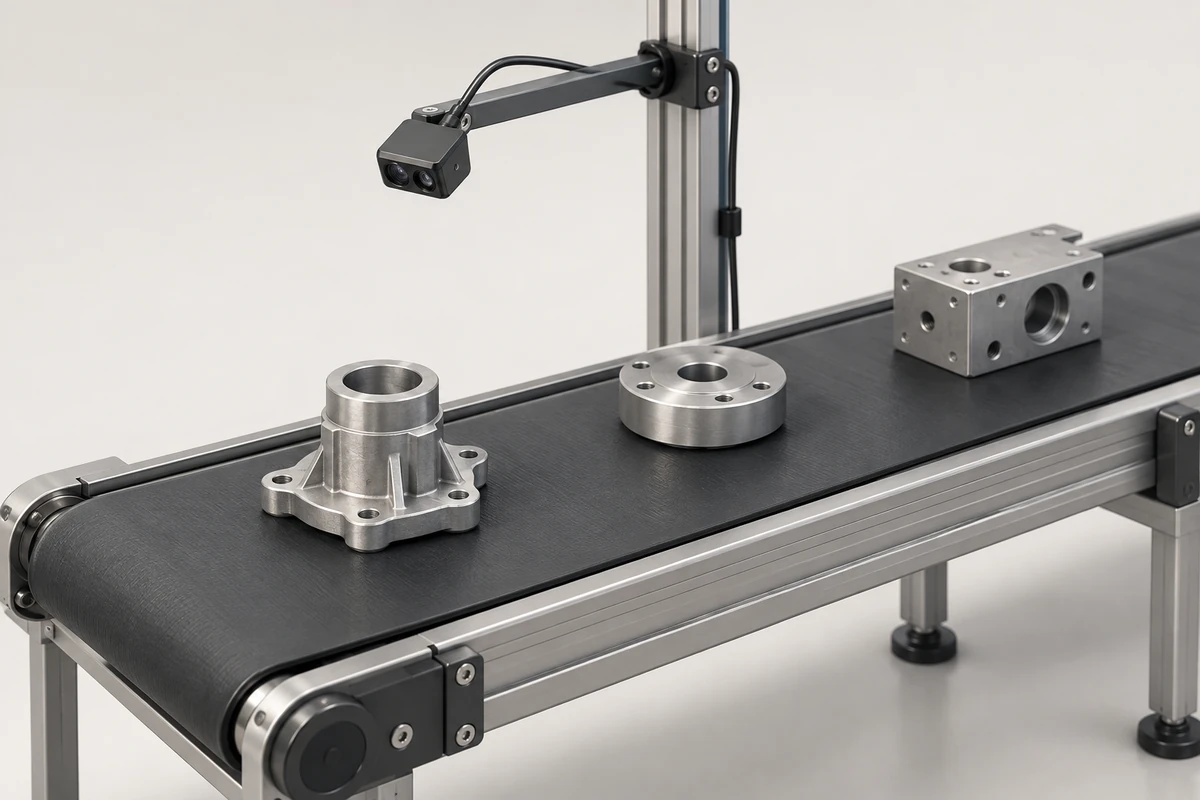
Machine-vision systems use image or depth data to make a defined production decision. A ToF camera supplies surface geometry for tasks such as part location, height checking and robot guidance. Choosing it starts with the feature to measure and the tolerance the complete system must meet.
Map appearance inspection and 3D geometry tasks
Monochrome imaging can support contrast-based features under suitable illumination. Color adds information for appearance, print and color-based sorting. Depth provides geometry such as surface height, separation from a background and three-dimensional position. RGB-D combines appearance and depth when both matter to a decision.
A packaging line may need to inspect label print and measure carton dimensions. Treat these as separate requirements: fine print depends on image sampling, focus and lighting, while the outer envelope depends on calibrated geometry and visible edges. Neither task is established by the other camera stream's resolution.
Match distance, spatial sampling and tolerances
Calculate the field of view at the working distance and the samples across the smallest relevant feature. Include near and far positions, lens distortion and edge coverage. Image resolution describes sampling; depth uncertainty and calibration determine how well those samples support a measurement.
For example, a hypothetical 640-sample image spanning 1.28 m has 2 mm average lateral sampling on that plane. A 10 mm feature spans about five samples before edge and material effects. This calculation does not establish 2 mm dimensional accuracy. Test measured feature error against a reference across the actual working volume.
Compare depth technologies for target materials
| Input route | Evaluate on the real target |
|---|---|
| 2D monochrome or color | Contrast, lighting, lens focus, exposure and appearance variation |
| Stereo depth | Correspondence, texture, baseline, ambient light and occluded regions |
| Structured light | Pattern visibility, surface reflectance and projector-camera geometry |
| ToF depth | Return strength, ambient light, multipath, mixed pixels and integration settings |
Select the lens and illumination with the sensor configuration rather than changing them after calibration without review. Clear, glossy, dark and finely structured parts deserve dedicated tests. Compare the complete sensing and host arrangement under matched conditions.
Specify trigger, timestamps and host data
Define whether acquisition is free-running or coordinated with a machine event, and select hardware with the required documented interface. Associate each result with its capture time and part position. A camera's frame-rate specification does not establish external trigger support or controller latency.
Agree on units, coordinate frame, invalid values and result-age limits. The host can transform depth into points, segment a part and communicate a decision to automation. PLC integration, robot protocol and application software should be selected for that system architecture.
Plan mounting, thermal path and factory integration
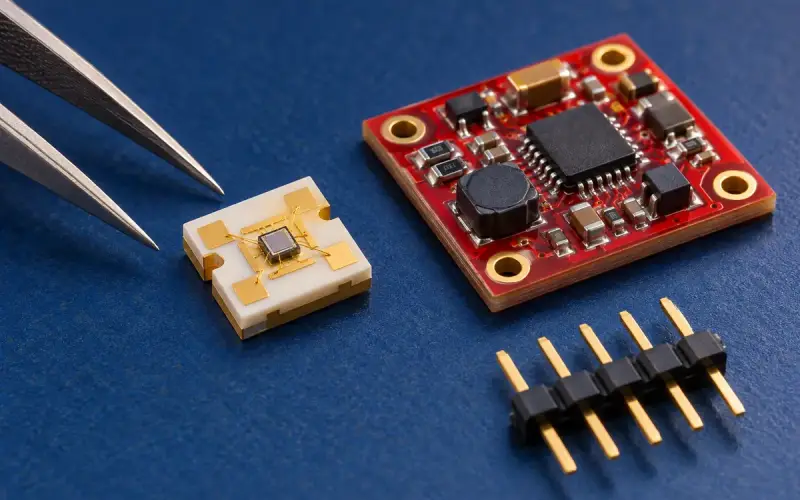
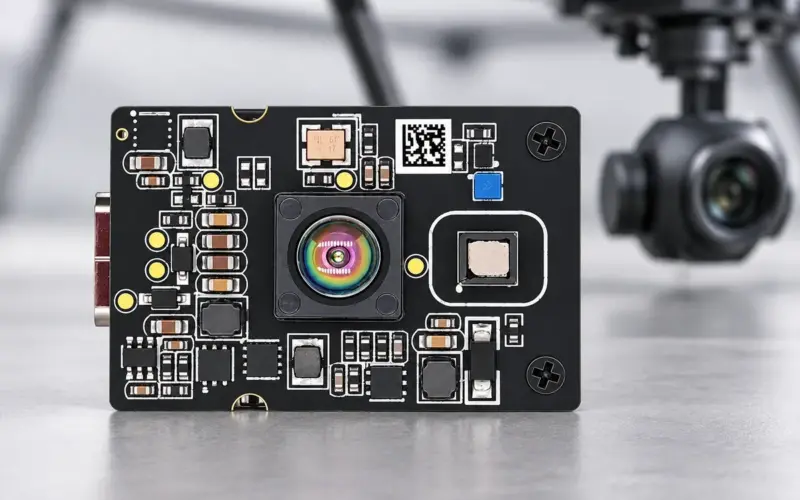
DM-RGBD5003A provides USB 2.0 RGB-D with 640 × 480 depth up to 25 fps. DM5005A provides 320 × 240 USB depth up to 30 fps; its 940 nm option covers 0.2–2 m and its 850 nm option covers 0.3–5 m. Its bare-board configuration calls for enclosure and thermal design. DMOM2808D supplies a MIPI route for an embedded host.
Check vibration, mounting repeatability, ambient temperature, cover optics and maintenance access. Validate the installed assembly and its measurement drift, including after cleaning and remounting. General camera geometry and personnel-protection functions have different system requirements.
Choose an application-specific evaluation route
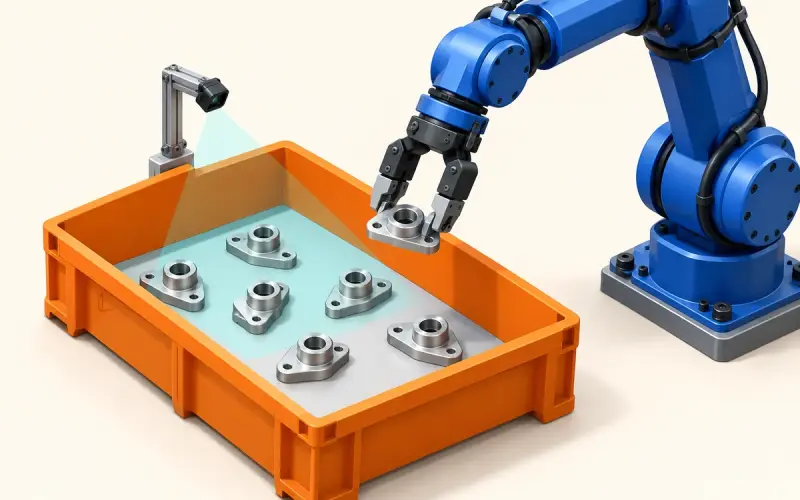
Use robot bin picking for pose and grasp validation, parcel dimensioning for length-width-height rules, and 3D reconstruction for multi-view models. Bring sample parts, inspection criteria, working distance and cycle timing to a DOMI evaluation discussion so we can match the data route to the production task.
Discuss your evaluation with DOMI.
FAQs
When should machine vision use RGB-D?
Use it when the decision needs both appearance and geometry, such as color-based separation plus a 3D pick position. Check calibration and timing for the two streams on moving targets.
Does depth resolution specify measurement accuracy?
Resolution specifies the number of samples. Accuracy for a measured feature also depends on depth error, optics, calibration, surface properties and the measurement algorithm.
What belongs in a camera evaluation sample set?
Include the smallest relevant features, surface finishes, working distances, lighting, object motion and acceptable process variation. Compare the final decision against an appropriate reference.
Which integration details should be provided to DOMI?
Provide the host interface, acquisition timing, working volume, tolerance, cycle time and enclosure constraints. These establish the camera and processing requirements for the cell.