
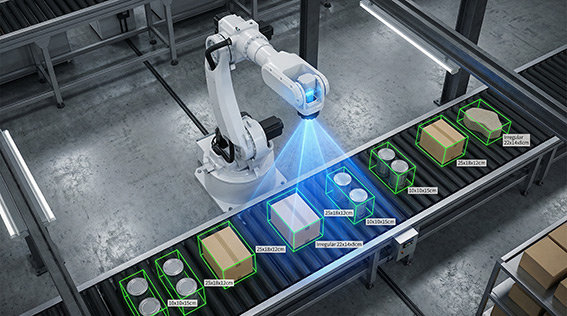
3D depth data can help an industrial robot locate parcels, select a grasp, measure an object’s envelope, and verify an empty placement zone. A ToF camera is one possible depth source. The outcome depends on camera placement, calibration, software, material properties, cycle time, and the robot’s control system.
From depth image to a robot action
A typical pipeline captures depth, removes invalid pixels, transforms points into the robot coordinate frame, segments candidate objects, estimates pose or dimensions, proposes a grasp, and checks the result after movement. Each stage can fail independently. A depth sensor does not itself identify a SKU, calculate a safe trajectory, or guarantee a successful pick.
Sorting and palletizing
For mixed cartons and bags, test edges, overlap, folds, dark surfaces, labels, and reflective wrapping. RGB-D can help distinguish objects when color information is actually needed, but the RGB and depth streams require synchronization and calibration. Validate grasp success and throughput on the real mix of goods; do not infer them from sensor frame rate alone.
Volume measurement
A top-view depth map can estimate height above a calibrated reference plane. Combining height with the segmented footprint gives an envelope or approximate volume. Report which volume is measured: bounding-box volume, displaced volume, or a shipping dimension. Occluded sides and deformable packaging limit any single-view estimate.
Industrial machine-vision checklist
- Define the working distance, field of view, spatial resolution, depth uncertainty, and required cycle time.
- Calibrate camera-to-robot pose and recheck after mounting or temperature changes.
- Measure missing-depth rate under expected ambient light and material reflectance.
- Use an appropriate separately validated safeguarding system where personnel protection is required; a general-purpose ToF camera is not a safety-rated protective device by implication.
Choose a current product model only after matching its datasheet and test conditions to the workcell. The legacy application articles referenced several different and sometimes inconsistent model names; their unverified numerical claims have not been carried into this guide.