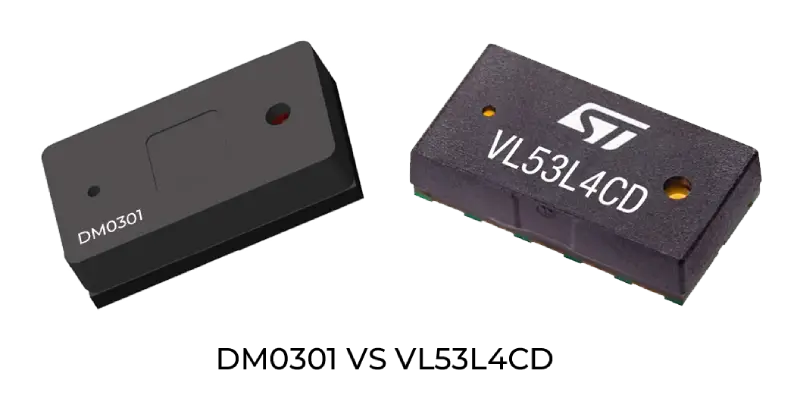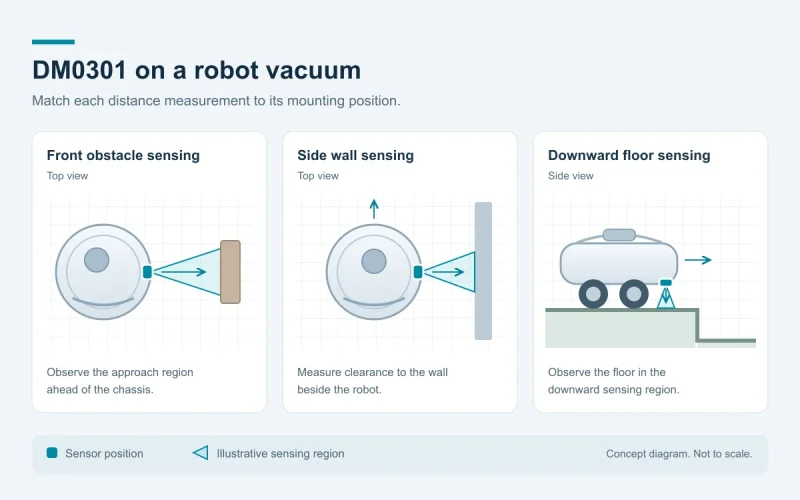

DM0301 provides a compact single-point ToF distance channel with indoor ranging up to 4 m, I2C host control and a 4.40 × 2.40 × 1.00 mm optical LGA package. For teams comparing it with ST sensors, the useful distinctions are the required distance, sensing region, output behavior and integration work for each specific model.
VL53L0X, VL53L1X and VL53L3CX serve different selection needs. VL53L0X offers ranging up to 2 m in a compact package. VL53L1X combines ranging up to 4 m with a programmable receiver region of interest. VL53L3CX supports multiple target distances within one field of view and ranging up to about 3 m. This guide compares their specifications with DM0301 and connects those differences to a practical evaluation plan.
Technical specifications by model
The table compares component specifications. Maximum distances depend on each sensor’s measurement conditions and configuration; use them to shortlist candidates for the application’s working distance.
| Selection parameter | DM0301 | ST VL53L0X | ST VL53L1X | ST VL53L3CX |
|---|---|---|---|---|
| Distance specification | Indoor up to 4 m; nominal configurable range 20 mm–5 m | Up to 2 m | Up to 4 m in long distance mode | Up to about 3 m |
| Sensing output or control | Single-point processed distance | Single-zone distance | Distance with programmable receiver ROI | Multiple target distances within one FoV |
| Package dimensions | 4.40 × 2.40 × 1.00 mm | 4.4 × 2.4 × 1.0 mm | 4.9 × 2.5 × 1.56 mm | 4.4 × 2.4 × 1.0 mm |
| Supply voltage | 2.97–3.63 V; 3.3 V typical | 2.6–3.5 V | 2.6–3.5 V | 2.6–3.5 V |
| Maximum sensor I2C rate | 1 Mbit/s | 400 kHz | 400 kHz | 1 MHz |
| Integration starting point | DM0301 initialization, firmware loading and ranging sequence | Model-specific ST API | Model-specific ST driver and ROI configuration | Model-specific ST driver and multitarget result handling |
DM0301’s nominal 5 m configuration is separate from its indoor ranging specification up to 4 m. For VL53L1X, reaching 4 m uses long distance mode with a 140 ms timing budget in dark conditions on a white target. VL53L3CX’s distance depends on target reflectance, ambient infrared light and timing budget; its detailed performance tables specify these conditions. The maximum I2C rate describes bus communication speed, rather than the number of distance measurements per second.
Choose the sensing behavior for your application
DM0301 for compact single-point sensing
DM0301 combines a miniature optical package with an indoor distance channel for proximity detection, touchless activation and auxiliary distance sensing in compact equipment. Its 25° FoV helps define the target area around the installation direction. Build the shortlist around the target’s size, reflectivity and nearest and farthest operating positions.
For projects considering DOMI’s lower sensor purchase cost positioning, we can discuss pricing for the required configuration and quantities. Include host integration, optical calibration and qualification in the complete project budget.
VL53L0X for a compact distance channel up to 2 m
VL53L0X is a candidate when the required working distance fits its range and the design uses its existing software resources. DM0301 offers a longer indoor range specification in the same stated package dimensions. Compare both devices with the actual target and enclosure when choosing the distance margin for the application.
VL53L1X for a programmable sensing region
VL53L1X lets the host adjust the receiver ROI to narrow the sensing region. This is useful when the design needs to focus the measurement on a selected area. DM0301 and VL53L1X both have a headline distance up to 4 m; select the sensor around sensing-region control, package clearance and the required distance and update-time combination.
VL53L3CX for multiple target distances
VL53L3CX provides multitarget distance measurements within its field of view. This output is relevant when objects at different distances can appear in the sensing area. Define how the application will select or use those target results. DM0301 provides a single-point distance channel; choose the output behavior that fits the task.
Plan the board and host integration
Package, supply and optical clearance
Use the selected model’s pinout, land pattern and optical reference drawings during schematic and layout review. Package dimensions alone do not establish a complete replacement path. Allow room for the sensor height, cover-glass spacing and optical openings, and review the supply rail and I/O pull-ups together.
DM0301 uses a typical 3.3 V supply with a recommended range of 2.97–3.63 V. When adapting a board powered at 2.8 V, include the sensor supply in the redesign review. Apply the selected sensor’s I/O configuration and electrical limits to SDA, SCL, XSHUT and GPIO1.
DM0301’s pin-to-pin hardware replacement positioning applies to VL53L4CD. Our dedicated VL53L4CD replacement guide covers that board-level starting point, supply, software and optical work.
Sensor-specific software
Use each model’s host software for initialization, configuration, result acquisition and calibration. DM0301 Rev. 0.3 uses the 7-bit I2C address 0x41 and a startup sequence that includes firmware loading before ranging. Adapt the acquisition workflow and result interpretation alongside the hardware.
Our DM0301 and ESP32 integration guide explains wiring planning, I2C setup and the sensor startup workflow. Choose a bus rate supported by both the sensor and the host controller.
Evaluate distance, timing and enclosure together
Create a common application test plan for the shortlisted sensors, then record the configuration used for each device.
- Define the target material, size, angle and required working-distance interval, including dark and reflective objects relevant to the product.
- Test the assembled optical window and enclosure under the intended ambient lighting and temperatures.
- Select the timing budget and measurement interval for the required response time, and log valid-result rate as well as distance error.
- Compare readings against a distance reference. Record mean error, repeatability and invalid readings separately at representative distances.
- Measure supply current under the selected acquisition schedule, and exercise startup, restart and communication recovery.
This process connects sensor selection to the product’s detection task. A cover-glass or contamination test should use the final optical assembly and the sensor’s calibration procedure. Accuracy and power comparisons are most useful when the test record includes distance, target, lighting, timing and calibration settings.
FAQs
How does DM0301 compare with VL53L0X for working distance?
DM0301 supports indoor ranging up to 4 m, while VL53L0X supports ranging up to 2 m. Both have stated package dimensions of 4.4 × 2.4 × 1.0 mm. Evaluate the required distance with the application's target, ambient light and final optical window.
What distinguishes VL53L1X from DM0301?
VL53L1X offers a programmable receiver ROI for adjusting the sensing region. Both devices have a headline range up to 4 m, with model-specific conditions. Package dimensions, supply requirements and host software also form part of the selection.
What is VL53L3CX’s multitarget output useful for?
VL53L3CX can report target distances when multiple objects are present within its field of view. This supports applications that use more than one target result from a sensing direction. Define the required target-selection behavior alongside the working distance and timing.
What does a DM0301 migration involve?
Plan the sensor supply, pinout and optical assembly, then integrate DM0301's initialization, firmware loading and ranging workflow. Its pin-to-pin hardware replacement positioning is specific to VL53L4CD; review other sensor designs against their own drawings and electrical requirements.
What information helps DOMI recommend an evaluation path?
Share the current sensor, host MCU, supply rail, target material and distances, ambient lighting, cover glass and expected quantities. We can help define a DM0301 evaluation around the product's sensing task and integration requirements.
Technical resources and next steps
Specification references reviewed on October 14, 2026: DM0301 Rev. 0.3, December 4, 2023; ST VL53L0X DS11555 Rev. 6, June 2024; VL53L1X DS12385 Rev. 8, August 2024; VL53L3CX DS13204 Rev. 9, August 2024.
- DM0301 specifications and application overview
- ST VL53L0X datasheet
- ST VL53L1X datasheet
- ST VL53L3CX datasheet
- ToF sensor selection by sensing task
For a new design or an existing sensor comparison, discuss your distance-sensing application with us. We can help connect the working-distance, integration and sourcing requirements to a DM0301 evaluation.