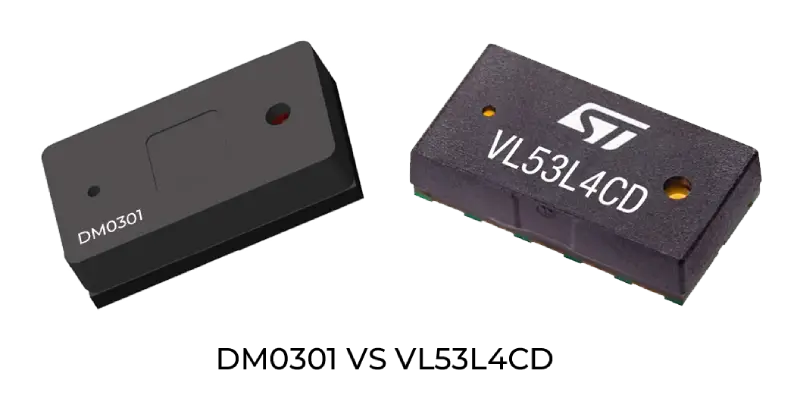

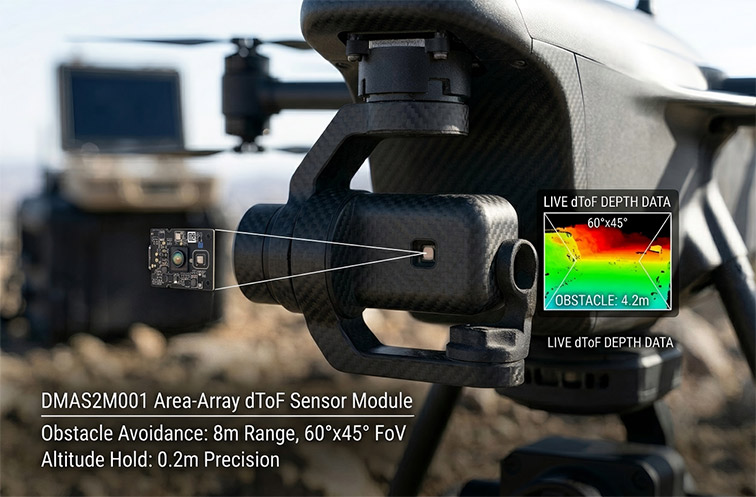
Bring area-based distance data to compact robot and UAV designs with DOMI’s DMAS2M001. Its hybrid-stacked SPAD receiver and 940 nm VCSEL form a 40 × 30 dToF array that outputs depth, point-cloud and confidence data at 10 fps. Across a 60° × 45° field of view, these samples give engineering teams a spatial input for evaluating obstacle zones, ground distance and other defined sensing regions.
At 7 g, with a cased envelope of 35.5 × 25 × 16 mm, DMAS2M001 gives space- and payload-conscious projects a compact area-depth option. Its USB-C and FPC interfaces, UDP and UVC protocol options, and Windows, ARM and Linux SDK platforms provide integration paths for embedded and development systems.
Where area-based dToF supports mobile sensing
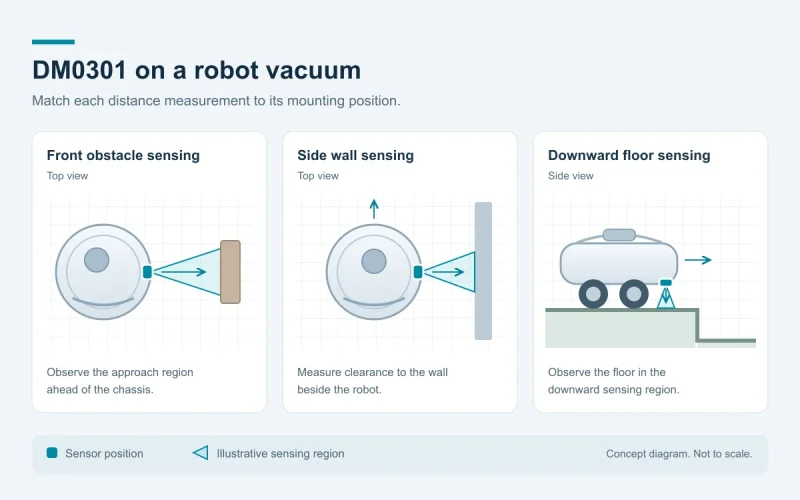
Robot perception and obstacle-zone evaluation
Use the 40 × 30 depth array as an input to robot perception software that works with selected regions of a scene. The confidence output can help the application distinguish depth samples by measurement confidence, while the 60° × 45° field of view gives the sensing design a defined area to work with.
For warehouse robots, service robots and other mobile platforms, start with the area where the system needs distance information. Relate mounting position, target size, distance and viewing angle to the samples available in that region. This gives the engineering team a clear basis for developing an obstacle-zone or floor-level sensing pipeline around the module’s output.
At 10 fps, the nominal interval between frames is 100 ms. As a simple timing example, a platform moving at 1 m/s travels 0.10 m between frames. Use this calculation as an initial sampling reference, then measure the complete application timing across acquisition, data transfer, processing and control.
For tasks that combine color with depth or need denser object contours, compare DOMI’s USB RGB-D cameras. For embedded designs that need a camera-module format, explore the ToF camera module range.
UAV distance and ground-region sensing
For a downward-facing UAV design, the array provides distance samples across the camera view. An application can use a selected ground region as an input to altitude estimation or terrain-following, with mounting geometry and aircraft attitude included in the calculation.
For forward-facing sensing, define the detection region around the aircraft’s motion and the response required from the complete system. The module’s range, frame cadence and field of view provide parameters for planning that evaluation. Test representative surfaces, distances, lighting and flight attitudes, and record valid-depth coverage alongside reference measurements.
See DOMI’s ToF camera selection guide for UAVs for a task-based selection process.
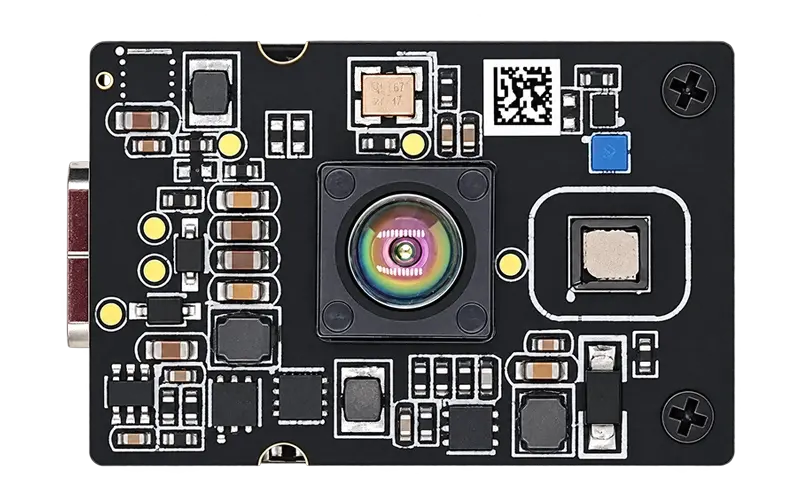
DMAS2M001 specifications
| Parameter | Specification |
|---|---|
| Ranging technology | Direct Time-of-Flight (dToF), hybrid-stacked SPAD array |
| Illumination | 940 nm VCSEL |
| Depth array | 40 × 30 |
| Frame rate | 10 fps |
| Distance range | 0.2–8 m for 10%–90% target reflectivity at 30 klux |
| Accuracy, 0.2–1 m | ±2 cm or better |
| Accuracy, 1–3 m | ±3 cm or better |
| Accuracy, 3–8 m | 1% or better |
| Field of view | 60° horizontal × 45° vertical |
| Physical interfaces | USB-C / FPC |
| Protocol options | UDP / UVC |
| Data outputs | Depth, point cloud and confidence data |
| SDK platforms | Windows / ARM / Linux |
| Supply | 5 V / 1 A |
| Power consumption | Approximately 1 W |
| Dimensions with casing | 35.5 × 25 × 16 mm |
| Weight | 7 g |
The distance range is specified for the reflectivity and ambient-light conditions shown above. Share the working distance, target material and lighting in your application to discuss an evaluation setup with DOMI.
Plan the host and data pipeline
DMAS2M001 offers USB-C and FPC physical-interface options, UDP and UVC protocol choices, and SDK platforms for Windows, ARM and Linux. Match the interface and software route to the host, data format and application framework in your design.
An integration plan can account for depth and confidence units, timestamps, calibration, coordinate conventions, power, mounting and the required output stream. DOMI can help map those project requirements to an evaluation configuration.
Make the evaluation useful to your design
Record the module and firmware revision, camera settings, distance, target material, lighting, mounting orientation, host configuration and reference measurement for each test. Track depth error and valid-data coverage as separate results, and measure end-to-end timing through the application pipeline.
For the intended task, include the system response to changing confidence, targets outside the selected range and gaps in incoming data. This gives the design team a practical record to use when tuning its sensing and control pipeline.
FAQs
What does DMAS2M001 provide for robotics and UAV designs?
DMAS2M001 combines a 40 × 30 SPAD dToF array with depth, point-cloud and confidence outputs. Robot and UAV teams can use those area-based distance samples as inputs to application-specific perception, ground-distance and obstacle-zone software.
What is the DMAS2M001 distance range?
DMAS2M001 has a 0.2–8 m range for targets with 10%–90% reflectivity at 30 klux ambient light.
What are the DMAS2M001 accuracy specifications?
DMAS2M001 specifies ±2 cm or better from 0.2–1 m, ±3 cm or better from 1–3 m, and 1% or better from 3–8 m.
Which interfaces and software platforms are available?
DMAS2M001 offers USB-C and FPC interface options, UDP and UVC protocol choices, and SDK platforms for Windows, ARM and Linux. Share your host and application framework with DOMI to discuss the suitable integration route.
Can DMAS2M001 be evaluated for downward UAV sensing?
Yes. Its area-depth output can be evaluated as a distance input for downward-facing ground-region sensing. Mounting geometry, aircraft attitude, target surface and the required application response belong in the evaluation plan.
Discuss a DMAS2M001 evaluation
Share your sensing task, working distance, target materials, lighting, host platform and output needs with DOMI. We can discuss a product configuration and an evaluation plan for your robot or UAV project.
Discuss your DMAS2M001 project with DOMI · Review DMAS2M001 specifications