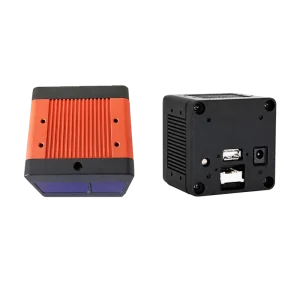

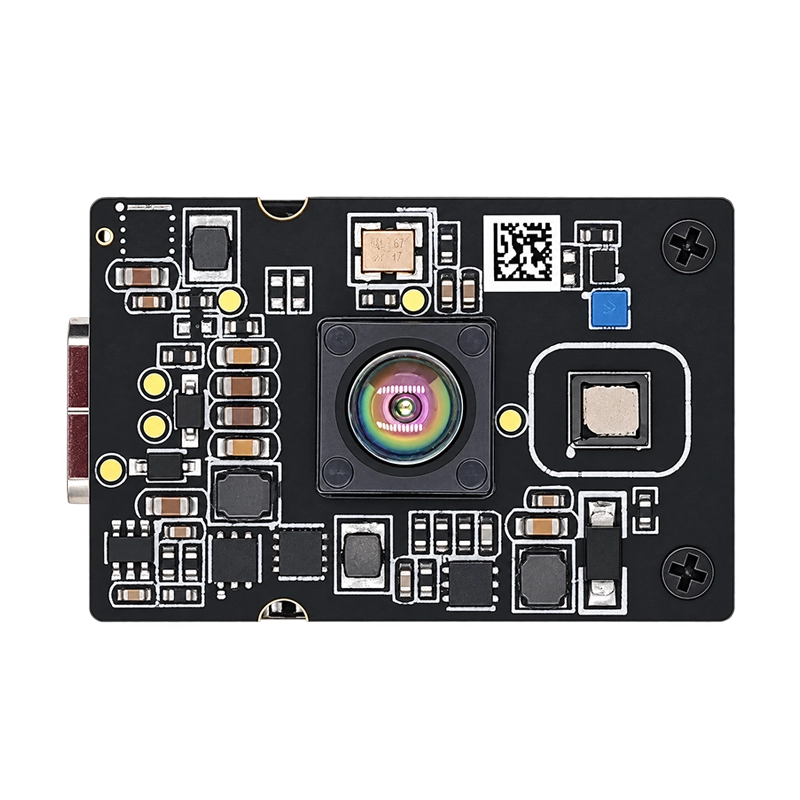
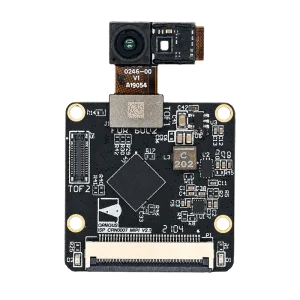
DMAS2M001 Compact 8 m SPAD dToF Array Module
DMAS2M001 gives compact robots and smart devices depth information across a 60° horizontal × 45° vertical field of view. A hybrid-stacked SPAD array and 940 nm VCSEL provide 40 × 30 depth data at 10 fps, with a 0.2-8 m range for targets from 10% to 90% reflectivity at 30 klux. Point-cloud, depth and confidence outputs support your host's spatial sensing pipeline.
Key Highlights
- Observe a sensing region with a 40 × 30 depth array across a 60° horizontal × 45° vertical field of view.
- Work across near and mid-range targets with 0.2-8 m ranging at 30 klux for 10-90% reflective surfaces.
- Bring spatial measurements and confidence information into your application through point-cloud, depth and confidence outputs.
- Accommodate depth sensing in small equipment with a 35.5 × 25 × 16 mm cased module weighing 7 g.
Overview
DMAS2M001 uses direct Time-of-Flight sensing to measure depth across an array. Its 40 × 30 resolution provides spatial samples within the sensing region, while the 10 fps frame rate defines the depth update rate for the host application.
Onboard processing includes calibration, peak detection and temperature compensation, followed by scattering correction, temporal filtering, flying-pixel filtering and an anti-sunlight algorithm. The output options let your application work with depth values, 3D points and confidence information.
- Resolution
- 40 × 30 at 10 fps
- Range
- 0.2-8 m @ 30 klux
- Field of View
- 60° H × 45° V
- Interface
- USB-C / FPC
Applications
Compact robotic perception
Use the depth array to observe defined regions around a robot, with point-cloud and confidence data available to the host pipeline. The module’s field of view and working range help you plan coverage around the target size and mounting position.
UAV distance sensing
For ground-facing or obstacle observation, DMAS2M001 supplies depth samples across a region. Its 7 g cased weight and compact dimensions help with payload and installation planning. Our DMAS2M001 robotics and UAV guide explains how array coverage, frame rate and host processing relate to these tasks. For aircraft selection, see our ToF camera guide for drones and UAVs.
Autofocus and monitored regions
Distance samples can serve as inputs for autofocus assistance or spatial observation in security equipment. Select the field of view and mounting position around the region your host application needs to observe.
Technical specifications
Depth sensing
| Parameter | Specification |
|---|---|
| Sensing principle | dToF with a hybrid-stacked SPAD array |
| Working range | 0.2-8 m at 30 klux; 10-90% target reflectivity |
| Accuracy at 0.2-1 m | ±2 cm or better |
| Accuracy at 1-3 m | ±3 cm or better |
| Accuracy at 3-8 m | 1% or better |
| Depth resolution | 40 × 30 |
| Frame rate | 10 fps |
| Field of view | 60° horizontal × 45° vertical |
| Illumination | 940 nm VCSEL |
| Module eye-safety classification | Class 1 |
Data and host integration
| Parameter | Specification |
|---|---|
| Output data | Point cloud, depth and confidence |
| Connector options | USB-C / FPC |
| Protocol options | UDP / UVC |
| SDK options | Windows and Linux; ARM platform support |
| Pre-processing | Calibration, peak detection, temperature compensation |
| Post-processing | Scattering correction, temporal filtering, flying-pixel filtering, anti-sunlight algorithm |
Mechanical and electrical parameters
| Parameter | Specification |
|---|---|
| Power supply | 5 V / 1 A |
| Power consumption | Approximately 1 W |
| Dimensions with casing | 35.5 × 25 × 16 mm |
| Weight | 7 g |
| Color | Black |
| Operating temperature | -20 to 60 °C |
| Storage temperature | -30 to 70 °C |
Integration planning
Start with the region your device needs to observe, then match the 40 × 30 spatial sampling and 10 fps update rate to that task. Choose the connector, protocol and SDK as part of the host configuration. We can help match the module’s data outputs to your processor and application software.
The module has a Class 1 eye-safety classification. Include the final optical window, enclosure and control electronics in the finished product’s laser-safety assessment.
FAQs
What range and lighting conditions does DMAS2M001 support?
The working range is 0.2-8 m at 30 klux with targets from 10% to 90% reflectivity.
What are the accuracy specifications?
Accuracy is ±2 cm or better from 0.2-1 m, ±3 cm or better from 1-3 m, and 1% or better from 3-8 m. Use the distance band relevant to your sensing task when planning reference measurements.
What data can my application use?
DMAS2M001 provides depth, point-cloud and confidence data from a 40 × 30 array at 10 fps. Depth values describe distance across the region, while point-cloud and confidence outputs provide further inputs for host processing.
What host integration options are available?
The module offers USB-C and FPC connector options, UDP and UVC protocol options, and SDK options for Windows, Linux and ARM platforms. We can help select the connector, protocol and output format around your host configuration.
How much installation space and power does the module need?
The cased module measures 35.5 × 25 × 16 mm and weighs 7 g. Power consumption is approximately 1 W, with a 5 V / 1 A supply requirement.
Discuss your array-depth application
Tell us the region you need to observe, target distance and materials, lighting and host platform. We can help choose a DMAS2M001 configuration and evaluation plan for your device.
Need help integrating DMAS2M001?
Get expert guidance from our sensing engineers on product selection, evaluation samples, system integration, and technical requirements for your application.
You May Also Like
DMOM2508CL
DM5005A
DMOM2501C