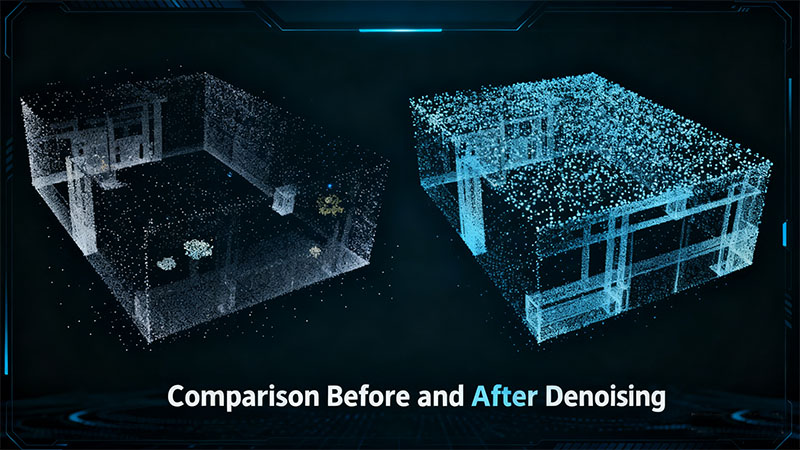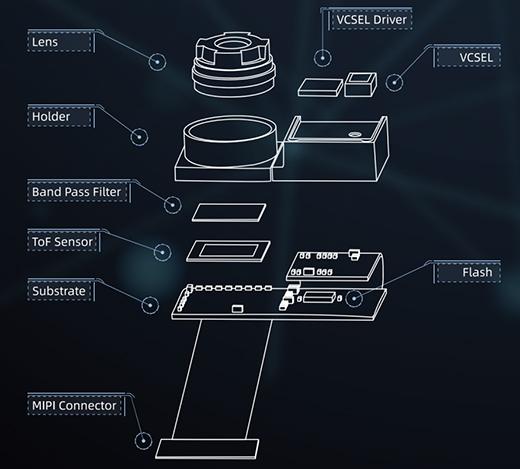

A Time-of-Flight (ToF) camera creates a depth map by measuring light returned from a scene. It can provide spatial distance information without relying on visible room lighting, but its useful range and data quality depend on the exact camera, target, and environment. Both direct-ToF and indirect-ToF cameras exist; a ToF camera is not necessarily a continuous-wave phase camera.
Advantages when the application fits
- Per-pixel depth: a depth image can help locate surfaces, estimate object dimensions, or define occupancy zones.
- Active illumination: a suitable system can measure in low visible light within its specified operating range.
- Direct geometry input: software can combine measured depth with RGB or other sensors for robotics, interaction, or inspection.
Limitations to test
- Weak or confusing returns: dark, transparent, shiny, angled, or partly occluded surfaces can produce missing or biased depth.
- Ambient light and other emitters: sunlight, cover reflections, and optical interference can reduce valid returns.
- Range and resolution trade-offs: pixel count does not by itself predict accuracy; exposure, illumination, processing, field of view, power, and target properties all matter.
- System functions: a depth map alone does not recognize a face, count people, or guarantee a safe stop. Those require algorithms and validation of the finished system.
How to compare cameras
Compare the same target reflectivity, distance, angle, ambient illumination, temperature, frame rate, and error definition. Ask for valid-return rate and error distribution as well as maximum range. For the underlying measurement methods, read the ToF sensor guide.