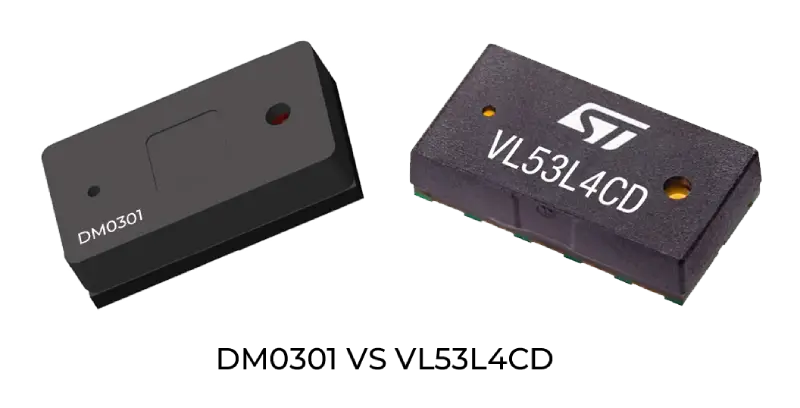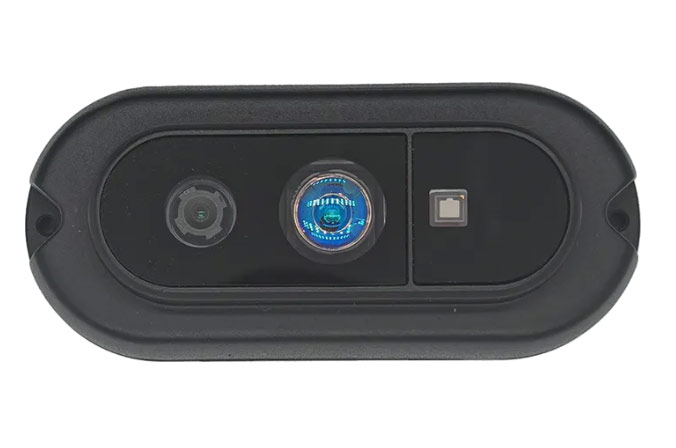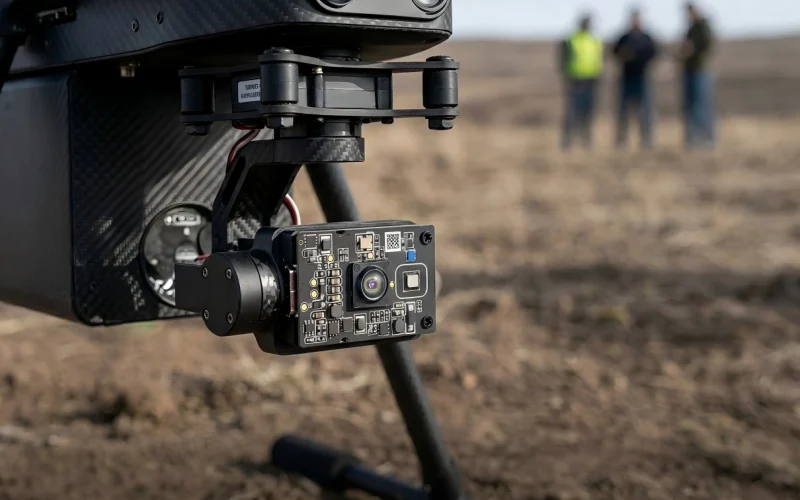

The DM0301 is a direct Time-of-Flight ranging sensor that can be evaluated for short-range smart-home functions. This guide focuses on how to define and test an integration. Use the current DM0301 datasheet and firmware documentation for electrical limits, dimensions, interface timing, optical performance, and laser classification; those properties cannot be inferred from the application alone.
Choose a concrete function
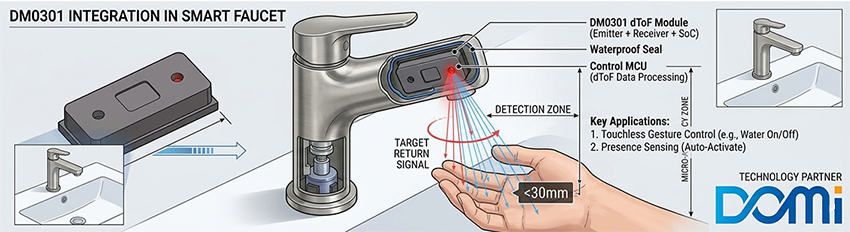
A smart faucet might need approach detection with few false triggers. A robot vacuum might need wall clearance or local obstacle distance. A smart appliance might need a wake-on-approach zone. These functions have different mounting, latency, power, and failure requirements. A single-point range does not create a depth image or recognize a gesture without additional sensing and software.
Mechanical and optical integration
Position the sensor so the relevant target stays within its field of view over the expected user heights and object sizes. If it sits behind a cover, confirm transmission at the operating wavelength and measure internal reflections and contamination effects. Verify offset and crosstalk after the final housing is assembled. Water droplets, fingerprints, and dark or shiny materials deserve explicit testing.
Firmware and validation
Read a measurement and its validity status at a rate appropriate to the control loop. Set hysteresis or time qualification to avoid repeated triggers around a threshold; handle invalid readings separately from a large distance. Measure energy use over the actual polling and sleep schedule. For a moving robot, include speed, braking distance, and worst-case latency in the acceptance test.
Do not promise a specific range, millimeter accuracy, immunity to direct sunlight, pin compatibility, or eye-safety classification without the matching manufacturer record and test conditions. Those claims must be checked for the exact production part and enclosure.