DOMI DMP300KP 905 nm pulsed VCSEL ceramic package
Wavelength 895-915 nm (905 nm typ.)
Peak Output 300 W typ. @ 61 A, 5 ns
Beam Divergence 40° H × 30° V typ.

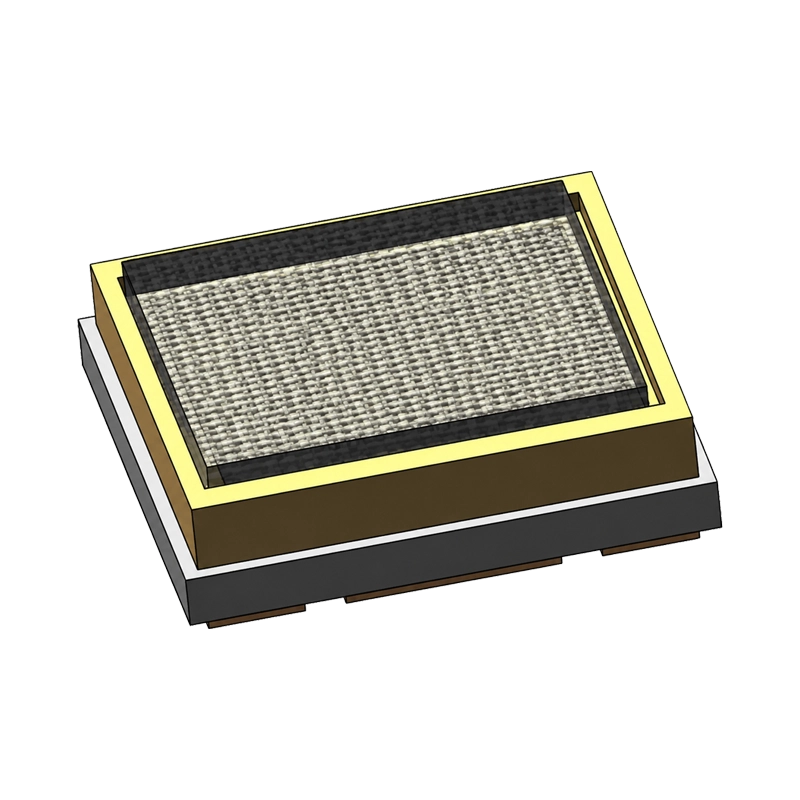
DMP300KP 905 nm 300 W Pulsed VCSEL in a 5.2 mm AlN Ceramic Package

The DMP300KP is a 905 nm pulsed VCSEL in a 5.2 × 5.2 × 1.55 mm AlN ceramic package. At Ts = 25 °C and IF = 61 A, the datasheet specifies 300 W typical optical output at a 5 ns pulse width and 0.025% duty cycle, with 40° horizontal × 30° vertical typical beam divergence.

Key Highlights

  • 895-915 nm peak wavelength (905 nm typical)
  • 300 W typical pulsed output at IF = 61 A, Tp = 5 ns, DC = 0.025%
  • 40° H × 30° V typical beam divergence
  • 4 nm maximum spectral width
  • 5.2 × 5.2 × 1.55 mm AlN ceramic package
  • Operating temperature: -20 to 85 °C
Engineering support Datasheet available

Overview

Designed for nanosecond-pulsed illumination, the DMP300KP addresses the ToF and 3D-sensing use cases named in the datasheet, including object avoidance, people-flow and volume measurement, gesture recognition, AR/VR and night vision. Its 40° horizontal × 30° vertical typical emission pattern provides a starting point for transmitter-optics design, but the datasheet does not define the divergence measurement convention or angular tolerance; confirm beam coverage with production samples.

For electrical and thermal integration, treat the published IF = 61 A, Tp = 5 ns and 0.025% duty-cycle condition as a characterization point rather than a general drive recommendation. The corresponding 300 W optical output is typical at Ts = 25 °C, while the absolute maximum table separately lists a 50 ns pulse-duration limit and 0.05% duty-cycle limit. Because recommended repetition rate, peak-current limit, junction temperature, thermal resistance and laser class are not specified, qualify driver margin, PCB thermal performance and optical safety in the final assembly.

Engineering Selection Points

  • Defined high-power pulse condition: 300 W typical output, 25 V typical forward voltage, 20% typical power-conversion efficiency and 5 W/A typical slope efficiency are specified at IF = 61 A, Tp = 5 ns and DC = 0.025%.
  • 905 nm spectral window: Peak wavelength is 895-915 nm with a 905 nm typical value. Spectral width is 4 nm maximum, and the wavelength coefficient is 0.06 nm/°C minimum and 0.07 nm/°C typical under the stated test condition.
  • Rectangular emission pattern: The datasheet gives 40° horizontal and 30° vertical typical beam divergence and shows the corresponding radiation pattern. It does not state the divergence measurement convention or tolerance, so final optics should be validated with production samples.
  • Compact ceramic package: The 5.2 × 5.2 × 1.55 mm AlN package provides positive, negative and center N.C. pads. The center pad may be used as a thermal pad according to the package drawing.
  • Documented environmental limits: The specified operating-temperature range is -20 to 85 °C and the storage-temperature range is -40 to 85 °C. ESD, EOS and surge controls are required during handling and integration.

Wavelength
895-915 nm (905 nm typ.)
Peak Output
300 W typ. @ 61 A, 5 ns
Beam Divergence
40° H × 30° V typ.
Package
5.2 × 5.2 × 1.55 mm AlN

Applications

The source specification lists night vision, ToF, gesture recognition, people-flow statistics, volume measurement, 3D scanning, avoidance and AR/VR. The following application groupings keep those stated use cases while identifying the system-level work still required.

Time-of-Flight and 3D Sensing

  • Target equipment: Pulsed ToF illumination units, 3D scanners and volume-measurement systems.
  • Technical rationale: The specified 905 nm wavelength, 300 W typical output at a 5 ns pulse condition and rectangular radiation pattern provide defined inputs for emitter-driver, receiver-filter and illumination-coverage evaluation. Range, accuracy, frame rate and ambient-light performance depend on the complete system and are not specified by this VCSEL datasheet.

Obstacle Avoidance and Spatial Counting

  • Target equipment: Avoidance sensors, people-flow counters and object-volume measurement nodes.
  • Technical rationale: Avoidance, people-flow statistics and volume measurement are explicitly listed applications. The 40° H × 30° V typical divergence can be used as an initial optical-coverage reference, subject to confirmation of the datasheet measurement convention and the final optical stack.

Gesture Recognition and AR/VR

  • Target equipment: Gesture-sensing illuminators, depth-perception modules and AR/VR spatial-input systems.
  • Technical rationale: Gesture recognition and AR/VR are listed in the specification. The low-profile ceramic package and pulsed optical characteristics support compact emitter evaluation, while diffuser selection, illumination uniformity, eye-safety classification and user-distance requirements remain system-level design tasks.

905 nm Night-Vision Illumination

  • Target equipment: Pulsed near-infrared illumination subsystems for night-vision evaluation.
  • Technical rationale: Night vision is listed as an application, and 905 nm is within the near-infrared sensitivity range of many silicon detectors. Detector compatibility, beam shaping, irradiance, repetition rate, thermal behavior and optical safety must be verified for the intended system.

Technical Specifications

The values below reproduce the DMP300KP Rev1.0 specification. Typical values are not guaranteed maxima, and the 300 W output applies only to the stated pulsed test condition.

Absolute Maximum Ratings

ParameterSymbolRating
Operating TemperatureTOPR-20 to 85 °C
Storage TemperatureTstg-40 to 85 °C
Pulse DurationTP50 ns
Duty CycleDC0.05%
Soldering Temperature–260 °C for 5 s
Absolute maximum ratings from DMP300KP Rev1.0. Do not use these limits as the nominal operating point.

Electro-Optical Characteristics

Source test temperature: Ts = 25 °C.

ParameterSymbolTest ConditionMinTypMaxUnit
Peak WavelengthλpIF = 61 A, Tp = 5 ns, DC = 0.025%895905915nm
Threshold CurrentItc––1.54.5A
Forward VoltageVfIF = 61 A, Tp = 5 ns, DC = 0.025%–2530V
Output PowerΦeIF = 61 A, Tp = 5 ns, DC = 0.025%–300–W
Slope EfficiencySEIF = 61 A, Tp = 5 ns, DC = 0.025%4.55–W/A
Power Conversion EfficiencyPCEIF = 61 A, Tp = 5 ns, DC = 0.025%–20–%
Beam Divergence HθHIF = 61 A, Tp = 5 ns, DC = 0.025%–40–deg
Beam Divergence VθVIF = 61 A, Tp = 5 ns, DC = 0.025%–30–deg
Spectral WidthΔλIF = 61 A, Tp = 5 ns, DC = 0.025%––4nm
Wavelength Coefficientdλ/dTIF = 61 A, Tp = 5 ns, DC = 0.025%0.060.07–nm/°C
Min, typical and max values are kept in their original columns. A dash means the Rev1.0 source does not specify a value.

Package and PCB Integration

The package drawing identifies a 5.20 × 5.20 mm body with a 1.55 mm height and a general dimensional tolerance of ±0.15 mm. In the datasheet bottom-view orientation, the two side pads are marked positive and negative, while the center pad is marked N.C. and may be used as a thermal pad.

Mechanical ItemSpecified ValueIntegration Note
Package Body5.20 × 5.20 × 1.55 mmUse the outline drawing as the dimensional authority.
General Tolerance±0.15 mmApplies per the drawing note.
Electrical PadsPositive / NegativeConfirm polarity in the bottom-view drawing before layout release.
Center PadN.C.The datasheet states that it may be used as a thermal pad.
  • Use the recommended solder-pad drawing rather than scaling dimensions from the product image.
  • Validate PCB copper, thermal vias, interface materials and peak junction temperature for the intended pulse train; thermal resistance is not specified in Rev1.0.
  • Confirm the beam-divergence definition, optical reference plane and production tolerance before freezing a diffuser, lens or receiver field of view.

Reflow and Handling

Pb-Free Reflow Profile

Profile FeaturePb-Free SnAgCu Assembly
Preheat / Soak150-200 °C for 60-120 s
Ramp-Up Rate3 °C/s maximum
Liquidus Temperature / Time Above217 °C / 60-150 s
Peak Package Body Temperature260 °C
Time Within 5 °C of Peak30 s
Ramp-Down Rate6 °C/s maximum
Time from 25 °C to Peak8 min maximum
The absolute maximum table separately lists a soldering-temperature rating of 260 °C for 5 s. Keep that rating distinct from the reflow-profile timing above.

ESD, EOS and Surge Protection

  • The VCSEL is sensitive to electrostatic discharge and electrical overstress; excessive ESD or EOS can damage the chip and degrade performance.
  • Provide surge protection in the drive circuit.
  • Ground personnel and equipment correctly, and use an ESD-controlled production environment with appropriate ionization and antistatic equipment.

FAQs

What optical output does the DMP300KP provide?

The DMP300KP provides 300 W typical pulsed optical output at Ts = 25 °C, IF = 61 A, a 5 ns pulse width and 0.025% duty cycle. Under the same condition, the typical forward voltage is 25 V and the typical power-conversion efficiency is 20%.

What operating mode is specified for the DMP300KP?

The DMP300KP is specified as a pulsed VCSEL. The 300 W characteristic is measured at a 5 ns pulse width and 0.025% duty cycle. The absolute maximum ratings list 50 ns pulse duration and 0.05% duty cycle; continuous-wave operation is not specified.

Is the DMP300KP suitable for ToF and 3D sensing?

Yes. The datasheet explicitly lists ToF, volume measurement and 3D scanning among the target applications. The 905 nm wavelength, 300 W typical pulsed output and 40° × 30° typical divergence provide defined emitter inputs, while range, accuracy and ambient-light performance must be validated in the complete system.

What wavelength and beam divergence should the optical design use?

Peak wavelength is 895-915 nm with a 905 nm typical value. The datasheet reports 40° horizontal × 30° vertical typical beam divergence, 4 nm maximum spectral width and a 0.07 nm/°C typical wavelength coefficient under the stated pulse condition. The divergence convention and tolerance are not stated, so confirm them before optical tooling release.

Does the DMP300KP package support a PCB thermal path?

Yes. The 5.2 × 5.2 × 1.55 mm AlN ceramic package includes a center pad marked N.C., and the datasheet states that this pad may be used as a thermal pad. Board-level copper, vias, attachment process and thermal performance still require validation for the intended pulse train.

What temperature and handling controls are specified?

The specified operating-temperature range is -20 to 85 °C and the storage range is -40 to 85 °C. The datasheet requires ESD and EOS precautions, surge protection, proper grounding and an ESD-controlled handling environment. It also provides a Pb-free SnAgCu reflow profile with a 260 °C peak package-body temperature.

Need help integrating DMP300KP?

Get expert guidance from our sensing engineers on product selection, evaluation samples, system integration, and technical requirements for your application.

You May Also Like

DMP1KKM

View Details

DMP200W

View Details

DMP20S

View Details