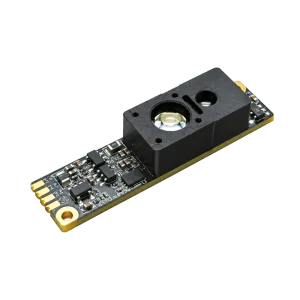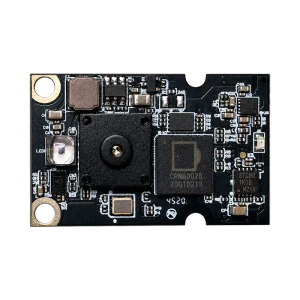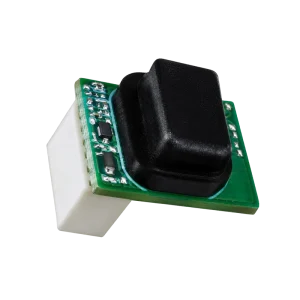

Proximity detection
- Presence and approach sensing in space-constrained smart devices
- Touchless triggers and near-object detection with processed distance output
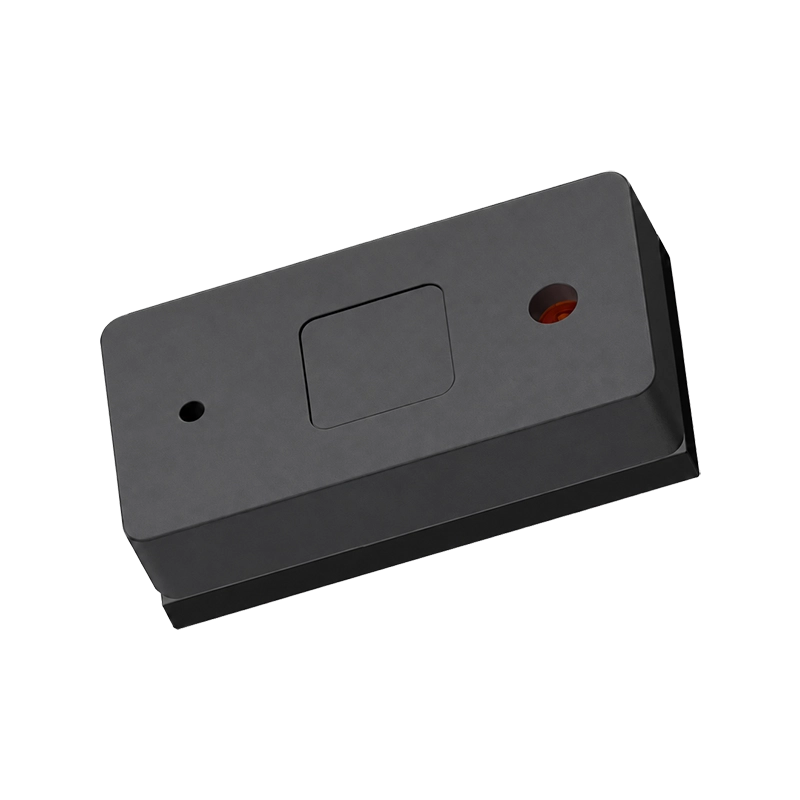
Upgrade existing ST VL53L4CD designs with a pin-to-pin compatible 940 nm 1D ToF sensor for accurate indoor ranging up to 4 m in a 4.40 × 2.40 × 1.00 mm optical LGA.
Key Highlights
| Qty | USD |
|---|---|
| 5000+ | $1.45 |
| 1000+ | $1.90 |
| 100+ | $2.20 |
| 10+ | $3.20 |
DM0301 is a pin-to-pin compatible hardware replacement for ST VL53L4CD designs. It is a miniature 940 nm direct time-of-flight (dToF) sensor for single-zone proximity and distance measurement, giving OEM teams a compact path to refresh existing products with a straightforward PCB migration strategy.
Inside the 4.40 × 2.40 × 1.00 mm package are a 940 nm VCSEL, SPAD array, microlens, time-to-digital converter, histogram memory and Arm Cortex-M0 MCU. The integrated architecture supports the same class of compact proximity and distance applications that make VL53L4CD designs attractive, while embedded crosstalk and anti-ambient-light algorithms provide a processed distance result instead of raw photon timing data.
Engineers can configure a nominal 20 mm to 5 m range and run at up to 50 Hz. The datasheet describes accurate indoor measurement up to 4,000 mm; final performance depends on target reflectivity, ambient light, cover glass, calibration and ranging settings. For VL53L4CD replacement projects, validate the final optical stack, calibration and ranging performance in the target enclosure.
DM0301 gives teams migrating from ST VL53L4CD a compact path to keep single-zone proximity and distance sensing in space-constrained products.
| Measurement principle | 1D direct Time-of-Flight with processed distance output |
| Emitter wavelength | 940 nm VCSEL |
| Nominal distance range | 20 mm to 5 m |
| Accurate indoor range described in datasheet | Up to 4,000 mm |
| Frame rate | Up to 50 Hz |
| Field of view (FOV) | 25° |
| Field of illumination (FOI) | 22° |
| Accuracy | TBD in datasheet revision 0.3 |
| Laser safety | Class 1, IEC 60825-1:2014 |
| Supply voltage | 2.97-3.63 V, 3.3 V typical |
| Typical current | 0.9 mA at 1 Hz; 17 mA at 30 Hz |
| Host interface | I2C, 7-bit slave address 0x41 |
| Maximum I2C rate | 1 Mbit/s |
| Control and data-ready pins | XSHUT and GPIO1 |
| Standby power consumption | TBD in datasheet revision 0.3 |
| Package | 12-pad optical LGA |
| Dimensions | 4.40 × 2.40 × 1.00 mm |
| Operating temperature | -20°C to 70°C |
| Storage temperature | -40°C to 85°C |
| ESD rating | ±2 kV HBM; ±500 V CDM |
| Latch-up immunity | ±100 mA |
| Compliance | RoHS and REACH |
| Standard packing quantity | 500 pieces per reel |
DM0301 combines a 3.3 V supply domain, I2C control and a data-ready GPIO in a 12-pad optical LGA. For VL53L4CD replacement projects, pin-to-pin compatibility is the hardware starting point. Validate the 7-bit I2C address 0x41, register map, firmware timing, optical stack and final cover glass during system qualification.
For best performance, calibrate the assembled optical stack under controlled conditions. The datasheet recommends offset calibration at 500 mm and requires the final cover glass to be considered. Its published no-ambient-light test setup used 90% cover-glass transmittance and a 0.36 mm air gap.
Yes. DOMI positions DM0301 as a pin-to-pin compatible hardware replacement for ST VL53L4CD designs. Validate the I2C address, register map, firmware timing, optical stack and final cover glass in the complete product before release.
Yes. The datasheet describes accurate indoor distance measurement up to 4,000 mm and a nominal configurable range from 20 mm to 5 m. Actual range depends on target reflectivity, ambient light, cover glass, calibration and ranging settings.
Yes. The datasheet specifies a 940 nm VCSEL and Class 1 laser safety to IEC 60825-1:2014. OEMs should still verify eye safety for the complete product, including the final cover glass, drive configuration and mechanical assembly.
Yes. It uses a 7-bit I2C slave address of 0x41 and supports bus rates up to 1 Mbit/s. A host can read results by polling or use the active-low GPIO1 data-ready interrupt, while XSHUT controls hardware standby.
Yes. Cover-glass calibration is supported. The datasheet recommends offset calibration at 500 mm under controlled conditions and says the final cover glass should be included during calibration for best ranging performance.
Get expert guidance from our sensing engineers on product selection, evaluation samples, system integration, and technical requirements for your application.